
Why this guide exists
Finland punches well above its size in engineering and design talent. It produced a generation of mobile and gaming companies, has a deep pool of senior software and product people, and sits in a European time zone that overlaps a US morning. For a US company building a remote European team, Finnish contractors are an easy, high-trust place to start.
The compliance picture is clean. Finland is a US income tax treaty country, the freelancer setup is standard with most contractors operating as a toiminimi (sole trader), and the items that look unfamiliar, such as Finnish ALV (VAT) and entrepreneur pension contributions, are Finnish domestic matters your contractor handles, not obligations that land on you.
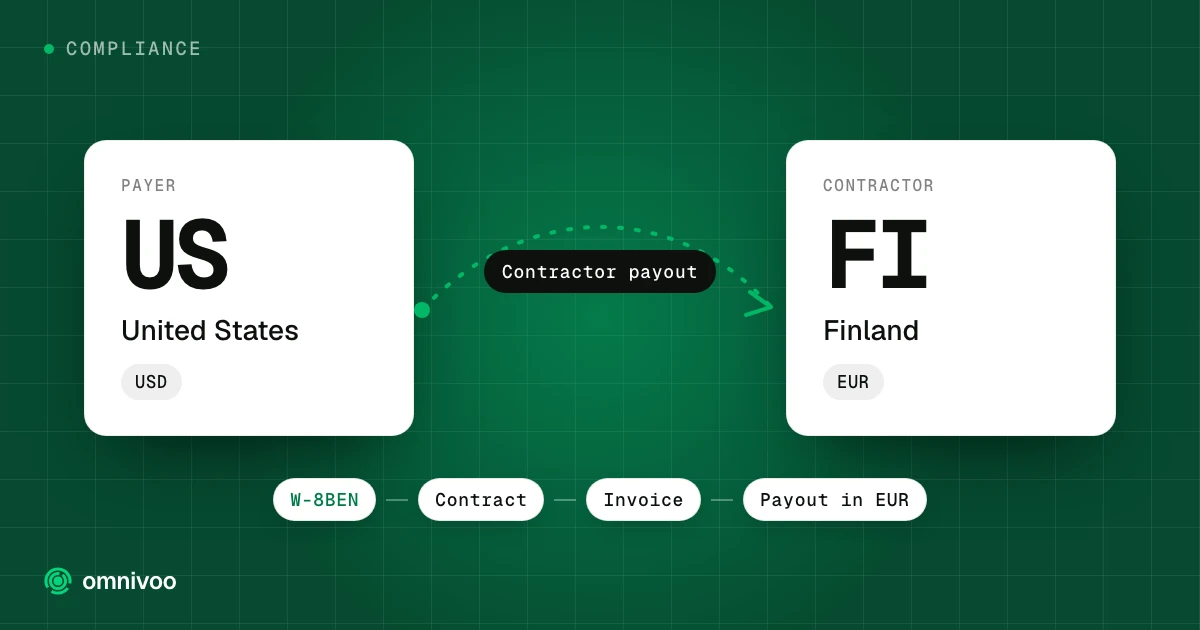
This guide covers what a US company needs to pay Finnish contractors. We cover the US side (W-8BEN, treaty application), the Finland side (toiminimi invoicing, ALV, the VAT threshold), and the payment rail decision. This is general information, not tax or legal advice. If you want to skip the assembly and let a platform handle it, Omnivoo Contract Management handles SOW drafting, W-8BEN collection, invoice capture, and FX settlement for $29 per contractor per month.
US side: what you need to do as the payer
Step 1. Collect a W-8BEN before the first payment
Before any invoice is paid, the Finnish contractor must complete Form W-8BEN and return it to you. The form certifies the contractor is the beneficial owner of the income, is a tax resident of Finland, and is not a US person. The IRS Form W-8BEN page has the current form and instructions.
The W-8BEN is valid for three calendar years after signature. If your contractor operates through a Finnish company (an Oy or similar), the form is Form W-8BEN-E, the entity equivalent, available on the IRS W-8BEN-E page. Our W-8BEN checklist walks through what to verify before the first payment.
Part II of the W-8BEN is where the contractor claims treaty benefits, citing Finland as the treaty country. This is filled in only when treaty benefits are needed on US source income.
Step 2. Confirm the work is performed in Finland
Under IRS source of income rules for personal services, the place where the personal services are performed generally determines the source of the personal service income, regardless of where the contract was made, the place of payment, or the residence of the payer. If your Finnish contractor does the work entirely from Helsinki, Tampere, Oulu, or anywhere else in Finland, the income is Finnish source income from the US perspective.
For a typical pure services engagement where the Finnish contractor never sets foot in the US, the result is: no withholding, no Form 1042-S, no 1099-NEC. The treaty sits in the background but does not change this analysis.
If the contractor visits the US for an onsite sprint, the days physically worked inside the US are US source days. The IRS allocates such income on a time basis, dividing US workdays by total workdays, so those days have to be allocated and may trigger withholding and a 1042-S. Keep a simple onsite-days log.
Step 3. Know the treaty for the edge cases
Finland is a US income tax treaty country. It appears on the IRS list of income tax treaties A to Z, and the treaty texts sit on the IRS Finland tax treaty documents page. The treaty governs the cases where your payment generates US source income.
Many founders never need the treaty articles because a contractor working entirely from Finland with no US presence has no US source income to begin with. For background on how treaties work in general, see our income tax treaty glossary entry.
For services payments where US withholding does apply, the Finnish contractor files Form 8233 to claim treaty benefits on the services portion, using the IRS Form 8233. For royalty type payments, the contractor relies on Form W-8BEN with the relevant treaty article entered in Part II. The contractor’s Finnish accountant identifies the correct article. For more on this mechanic, see our Form 8233 treaty exemption guide.
For independent personal services, the treaty generally allocates taxing rights so that a Finnish resident’s service income is taxable in the US only to the extent it is attributable to a fixed base or US presence the contractor maintains in the US. For a contractor working entirely from Finland with no US presence, there is no US source income to begin with, so treaty article citations are not needed. The treaty only enters the picture when US withholding would otherwise apply. Confirm the exact article and any limitation-on-benefits requirement with a qualified US tax advisor.
Finland side: what your contractor handles
You as the US payer are not in scope for Finnish taxes. The Finnish contractor is. Understanding the landscape helps you have an informed conversation about invoice format, ALV treatment, and the contractor’s setup.
The toiminimi and how a Finnish freelancer invoices
Most Finnish freelancers working with international clients operate as a toiminimi (sole trader, registered as a private trader) or through a light entrepreneur service that handles invoicing on their behalf. They invoice the US client directly for their fees and handle their own Finnish income tax and entrepreneur pension contributions (YEL) on the Finnish side.
The contractor’s invoice is your invoice. You as the US payer do not need to know the internal Finnish mechanics. You only need to receive a valid invoice and keep it in your packet alongside the W-8BEN and services agreement.
ALV (VAT) at 25.5 percent and why your invoice usually carries none
Finland’s standard ALV (VAT, locally Arvonlisävero) rate rose from 24 percent to 25.5 percent on 1 September 2024, per the Finnish Tax Administration (Vero). That rate applies to domestic sales of most goods and services inside Finland.
For B2B services sold to a US business customer, the result is usually different. Under the Finnish VAT rules on the international supply of services, the place of supply for services under the general rule is where the customer is established. When a Finnish contractor supplies B2B services to a US company, the place of supply is outside Finland, so the supply is generally outside the scope of Finnish VAT and the invoice carries no Finnish ALV.
Separately, a small Finnish business stays outside VAT entirely until it crosses the small-business VAT threshold, which Finland set at EUR 20,000 of annual turnover from the start of 2025. Below that, the contractor is not required to register for VAT and invoices VAT-free. The exact treatment depends on the contractor’s registration and the nature of the service, so confirm with their accountant.
Entrepreneur pension and Finnish income tax
A Finnish toiminimi pays their own Finnish income tax and YEL entrepreneur pension contributions, and registers for and remits VAT where required. These are Finnish domestic obligations the contractor manages. A US payer paying directly does not operate inside any of them. Your job is to pay the agreed fee against a valid invoice and keep clean records.
The payment rail decision
There are a few real options for paying a Finnish contractor from a US bank account. Finland uses the euro (EUR) and is part of the SEPA area.
| Rail | Typical FX margin | Speed | Notes |
|---|---|---|---|
| US bank SWIFT wire | 2 to 4 percent | 2 to 4 business days | Highest leakage |
| USD to EUR via SEPA-capable provider | Low | Same to next day | Lands EUR into a Finnish or EU account |
| USD or multi-currency balance provider | Low to tiered | Same to next day | Lets the contractor hold USD |
For USD-denominated invoices, a provider that lets the contractor hold a USD or multi-currency balance gives the most flexibility. For EUR payouts, choose a rail that converts USD to EUR at a fair rate and delivers via SEPA into the contractor’s Finnish bank account. A SWIFT wire remains a fallback for one-off larger payments, though it loses the most to FX margin. For a deeper comparison, see our guide on FX margin in international contractor payments.
Misclassification risk in Finland
Finland, like the rest of the EU, distinguishes a genuine independent contractor from a disguised employment relationship, and the authorities can look through a contract that walks and talks like employment. The risk is highest when the contractor has only one client (your US company), works fixed hours under your direction, uses your equipment, and is integrated into your team like an employee. A reclassification can carry retroactive entitlement to employee protections and contributions.
The mitigations are the same as in other markets: a properly drafted services agreement that establishes the contractor relationship in substance, a scope tied to deliverables not hours, evidence the contractor has other clients, and a documented review at six and twelve months. For more depth, see our guide on drafting an SOW for global contractors. The Omnivoo Contract Management SOW templates bake these protections in by default, including clear IP assignment and a governing law clause.
End-to-end workflow
Here is the clean version for a US company onboarding its first Finnish contractor.
- Send the contractor a B2B services agreement that defines deliverables, payment, IP assignment, and termination, anchored by a master service agreement and a statement of work.
- Collect a signed W-8BEN before any payment moves. Part II references Finland as the treaty country only when US source income is involved.
- Confirm the contractor’s setup (toiminimi, light entrepreneur, or company) and that they can issue a valid invoice for each payment.
- Pick a payment rail (a SEPA-capable EUR provider or a USD or multi-currency balance provider) and onboard the contractor’s payout details.
- Pay the invoice on schedule. Keep the W-8BEN, services agreement, invoice, and payment receipt together as a packet.
- Review the engagement quarterly for misclassification risk and refresh the W-8BEN every three years.
If you are also comparing rails across countries, our global contractor payment methods compared 2026 guide covers the broader options, and our guide on how to pay international contractors from the US walks the general framework. If you pay contractors elsewhere in Europe, see our guides on paying Swedish, Estonian, and German contractors.
When a platform pays for itself
A US founder paying one Finnish contractor can do this manually. A US team paying five or more European contractors faces enough W-8BEN refreshes, invoice confirmations, and FX margin questions that a platform pays for itself within a few months.
Omnivoo Contract Management costs $29 per contractor per month. We draft the B2B services agreement with Finland-specific IP and misclassification clauses, collect the W-8BEN, capture the contractor invoice on every payment, run the FX payment through a EUR or USD rail to avoid SWIFT leakage, and store the full packet for audit. Transaction fees are passed through at cost, with competitive FX and no fee for contractors, cancel anytime.
A simple sanity check
Three questions for every Finnish contractor relationship.
- Is there a signed W-8BEN on file and is it less than three years old?
- Will all the work be performed in Finland for the foreseeable future?
- Are we paying through a rail that handles EUR or USD cleanly and captures the contractor’s invoice for every payment?
If yes to all three, you are in great shape on the US-Finland stack. The remaining work is misclassification hygiene over time.
Want to skip the assembly entirely? See how Omnivoo Contract Management handles Finnish contractors end to end, or talk to our team about your specific setup. This guide is general information, not tax or legal advice.