
GUIDE
Free Independent Contractor Agreement Template for US (2026)
A free US independent contractor agreement template with 15 sections of sample clauses: scope, pay, IP assignment, confidentiality, and termination.
Reviewed by Rohan Sasne on May 24, 2026
A totalization agreement is a bilateral Social Security agreement between the United States and another country that eliminates dual Social Security taxation on the same earnings and fills gaps in benefit protection for workers who divide their careers between the two countries. The Social Security Administration administers the US program.
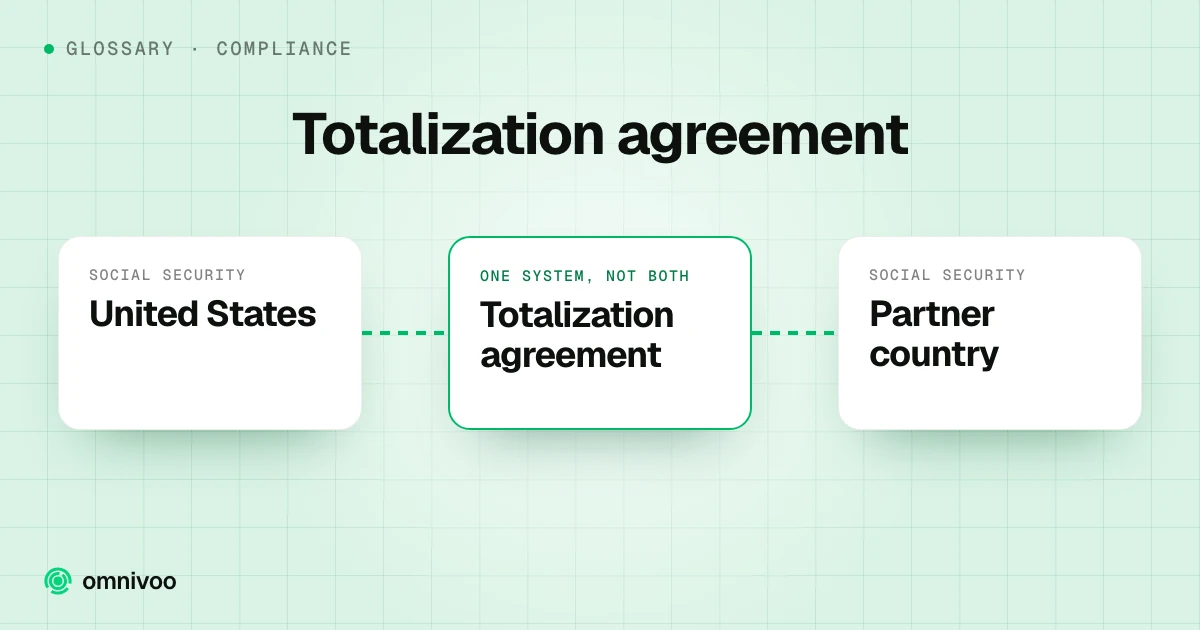
A totalization agreement is a bilateral Social Security agreement between the United States and another country that addresses two problems facing people who work across borders. The Social Security Administration states that these agreements, “often called ‘Totalization agreements,’ have two main purposes. First, they eliminate dual Social Security taxation, the situation that occurs when a worker from one country works in another country and is required to pay Social Security taxes to both countries on the same earnings. Second, the agreements help fill gaps in benefit protection for workers who have divided their careers between the United States and another country” (SSA, U.S. International Social Security Agreements). For US companies sending staff abroad or hiring across borders, a totalization agreement decides which country’s Social Security system a worker pays into and whether their foreign work counts toward a future benefit.
Without an agreement, a worker posted from one country to another can fall under both countries’ Social Security laws at once and owe contributions to each on the same wages. A totalization agreement resolves this by assigning coverage for a given period of work to a single country. The worker and employer then pay into that one system and are exempt from the other country’s Social Security taxes for that work. The country that keeps jurisdiction issues a certificate of coverage as proof of the exemption.
The second function is the “totalizing” itself. The SSA explains that the agreements help fill gaps in the coverage records of people who have divided their careers between two countries by combining, or totalizing, the periods of coverage earned in each country. A worker who lacks enough credits in either country on its own can use the combined record to qualify for a benefit.
The Social Security Administration administers the US program. The SSA directs anyone seeking more information about the totalization agreements program, including details about specific agreements in force, to write to its International Agreements Office of Data Exchange, Policy Publications, and International Negotiations (SSA, U.S. International Social Security Agreements). The IRS notes that totalization agreements “must be considered when determining whether an individual is subject to U.S. Social Security/Medicare tax, or whether a U.S. citizen or resident is subject to the social security taxes of a foreign country” (IRS, Totalization Agreements). The agreements are negotiated bilaterally, so the specific coverage rules and the list of partner countries vary. Check the current SSA list before relying on any particular agreement, because the set of countries changes over time.
Omnivoo Contract Management records where each cross-border worker is engaged and which country’s statutory contributions apply, so employers can keep coverage assigned to one system and hold the documentation a Social Security authority would expect.
Compliant agreements, IP assignment, and audit-ready records in one place.
An EOR is a third-party organization that legally employs workers on behalf of another company, handling payroll, taxes, benefits, and compliance in the worker's country.
Permanent Establishment (PE) is the tax-treaty concept that creates corporate income tax liability for a foreign enterprise in a host country when the enterprise carries on business there through a fixed place of business or a dependent agent who habitually concludes contracts on its behalf.
Stop worrying about Indian payroll and compliance terms. Omnivoo manages everything (PF, ESI, TDS, professional tax, and more).
Get startedFull details in our Terms of Service →