
GUIDE
How Much Does an Employer of Record Cost? (2026)
EOR pricing has layers: per-employee fees, setup, and deposits. What really drives the cost, plus Omnivoo's India EOR from $99/employee/mo.
Reviewed by Rohan Sasne on Jun 18, 2026
An Employer Identification Number (EIN) is a federal tax identification number that the IRS issues to identify a business entity. A US company generally needs an EIN before it can hire employees, run payroll, withhold and deposit employment taxes, and file the information returns the IRS requires.
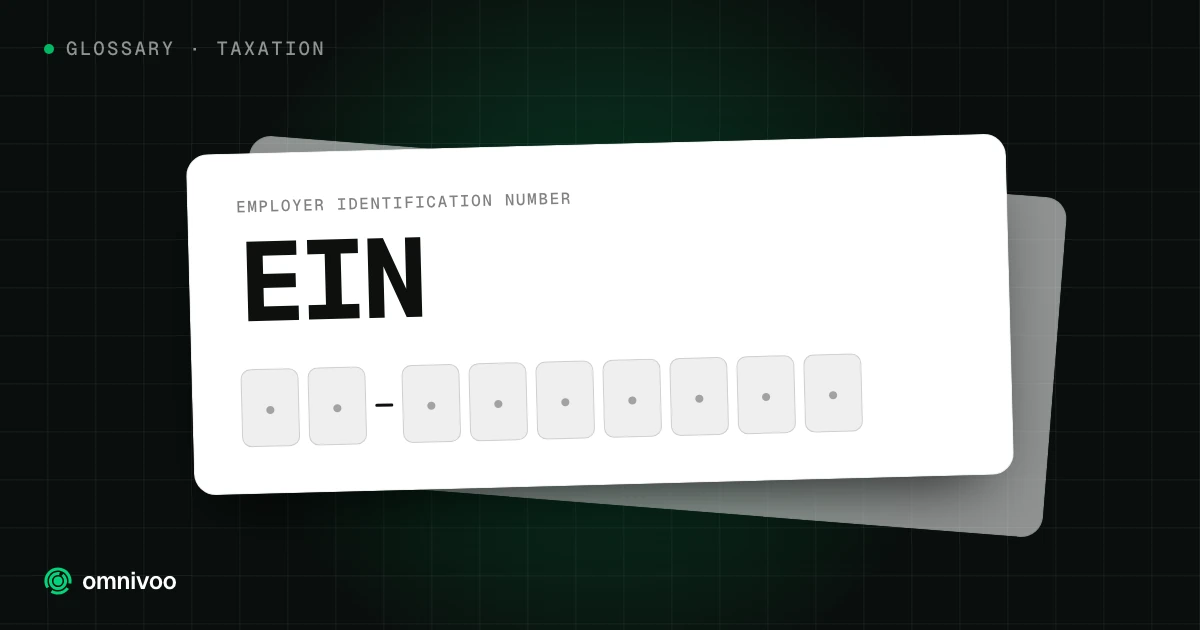
An EIN, short for Employer Identification Number, is the tax identification number the IRS assigns to a business so it can be identified in the federal tax system. The IRS notes that “businesses, organizations and some retirement trusts need an EIN to manage their taxes,” per its Get an Employer Identification Number page. For a US company, the EIN is the number that appears on payroll tax deposits, employment tax returns, and information returns filed with the IRS.
The IRS lists the situations that generally require an EIN. According to the same IRS page, you generally need an EIN to:
The first item is the one that matters most for payroll. A company cannot report wages or deposit withheld taxes without an EIN to attach those filings to.
Once a US company hires employees, the EIN becomes the account number for its employment tax obligations. Employers use Form 941 to “report federal income, social security, and Medicare taxes withheld from employee’s paychecks” and to report the employer’s share of Social Security and Medicare taxes, in the IRS wording. That return, the related deposits, and the year-end wage statements all reference the employer’s EIN. Without one, a company has no way to file these returns or remit the tax it has withheld.
The same logic extends to a US company acting as a withholding agent on payments to foreign persons. A withholding agent that deducts tax on US-source income and reports it to the IRS does so under its EIN, which ties the deposited tax and the information returns back to the paying entity.
Beyond payroll, the EIN is the number a business puts on the information returns it files with the IRS, such as wage statements for employees and the returns that report payments to contractors and foreign payees. The IRS uses the EIN to match those filings to the correct entity, which is why obtaining an EIN is one of the first steps when a company begins paying anyone in the United States.
A business applies for an EIN directly with the IRS. The IRS offers a free online application and also accepts Form SS-4, which the IRS describes as the form used to “apply for an employer identification number (EIN).” To apply online, the IRS requires that the applicant have a principal place of business in the US or US territories and that the responsible party have a valid Social Security number or ITIN. The IRS also limits issuance: per its online EIN application page, “you can apply for only 1 EIN per responsible party per day.” The IRS is explicit that the number is free: “Beware of websites that charge for an EIN. You never have to pay a fee for an EIN.”
Omnivoo handles US employment and contractor payments end to end, mapping each payroll filing and information return to the right entity so a company’s tax identifiers stay aligned with what the IRS expects.
Collect W-8BEN and W-9, sign country-aware contracts, and pay contractors in 220+ countries and territories.
An ITIN is a nine-digit tax processing number issued by the IRS to individuals who have a US federal tax filing or reporting requirement but are not eligible for a Social Security Number.
A withholding agent is any US or foreign person that has control, receipt, custody, disposal, or payment of US-source income to a foreign person, and is required to deduct, withhold, and pay over the tax under chapters 3 and 4 of the Internal Revenue Code, with personal liability for any tax not withheld.
Under the US Corporate Transparency Act, a beneficial owner is an individual who, directly or indirectly, exercises substantial control over a reporting company or owns or controls not less than 25 percent of its ownership interests, with the definition codified at 31 USC 5336(a)(3) and implemented through FinCEN regulations.
The Beneficial Ownership Information (BOI) report is the filing required by the US Corporate Transparency Act under which reporting companies disclose the identity of their beneficial owners and company applicants to the Financial Crimes Enforcement Network (FinCEN), with scope narrowed by a FinCEN interim final rule of 21 March 2025 to apply only to foreign entities registered to do business in a US State or Tribal jurisdiction.
A disregarded entity is a business with a single owner that is not treated as an entity separate from its owner for federal income tax purposes. This is the default classification for a domestic single-member LLC that does not elect corporate treatment, so the LLC's activity is reported directly on the owner's return.
Form SS-4 is the IRS Application for Employer Identification Number (EIN). A US business files it to obtain the nine-digit EIN it uses to run payroll, deposit employment taxes, and file information returns such as Form 1099-NEC.
Form W-8BEN-E is the IRS certificate a foreign entity gives a US payer to document non-US status, FATCA classification, and any treaty claim on US-source income.
Form W-9 is the IRS form a US person gives a payer to certify their taxpayer identification number and avoid 24% backup withholding on reportable payments.
Collect the right tax form before you pay, sign a country-aware contract, and pay contractors in 220+ countries and territories. $29 per contractor per month.
Get startedFull details in our Terms of Service →