
COMPARISON
Best Contractor Management Platforms for Global Teams in 2026
13 contractor management platforms for global teams compared on price, contracts, tax forms, payouts and what your contractor pays. Verified October 2026.
Reviewed by Rohan Sasne on Apr 13, 2026
Constructive receipt is the cash-method tax doctrine under which income is treated as received, and therefore taxable, when an amount is credited to the taxpayer's account or made available without substantial restriction, even if the taxpayer has not physically taken possession of it. It fixes the year a cash-basis taxpayer must report income to the period the money first became available.
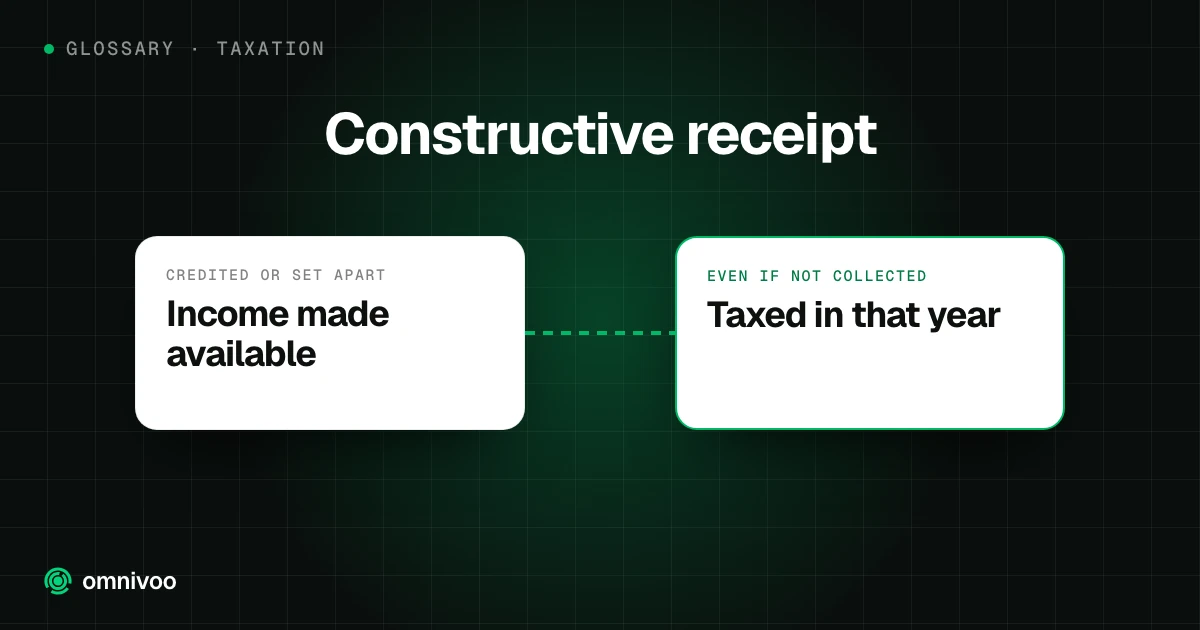
Constructive receipt is the rule that decides the year a cash-basis taxpayer must report income. Under the cash method, you generally report income in the year you receive it. The doctrine extends “receive” beyond physically holding the money. The IRS explains in Publication 538 (Accounting Periods and Methods) that “income is constructively received when an amount is credited to your account or made available to you without restriction.” The point is to stop a taxpayer from choosing a tax year by simply delaying when they pick up money that is already theirs to take.
The test is availability, not possession. Publication 538 states plainly that “you do not need to have possession of it.” Once funds are credited to your account or set aside so you can draw on them without a substantial limit, the tax law treats you as having received them. The same rule covers money received through an agent: the IRS notes that “if you authorize someone to be your agent and receive income for you, you are considered to have received it when your agent receives it.”
A substantial restriction is the dividing line. If you genuinely cannot reach the money before year-end, for example because a condition has not yet been met, there is no constructive receipt. If the only thing standing between you and the cash is your own decision not to collect it, the income is constructively received and taxable in that year.
Publication 538 illustrates the doctrine with interest. A bank credits interest to your account in December, but you do not withdraw it or enter it in your records until January of the next year. You must include the interest in income for the December year, because that is when it was credited and made available.
The same logic governs a cash-basis contractor’s income. Suppose a client makes a payment available in late December, but the contractor does not pick up the check or move the funds until January. Because the money was available without substantial restriction in December, it is December income. The contractor cannot push it into the next tax year by choosing to collect it later.
Most independent contractors are cash-method taxpayers who report business income on Schedule C. Constructive receipt sets the year that income lands, which in turn affects the year it is included when figuring estimated taxes. Misjudging the year can understate income in one period and overstate it in the next, and can affect whether a quarterly estimated payment was large enough.
The practical takeaway is to track when payments became available, not only when they were deposited. A payment available on December 31 belongs to that year even if it clears the bank in January.
Omnivoo Contract Management records each contractor payment with the date it was made available, giving cash-basis payees a clear timeline for the year their income belongs to.
Collect W-8BEN and W-9, sign country-aware contracts, and pay contractors in 220+ countries and territories.
Estimated taxes are the periodic payments the IRS uses to collect income tax, and other taxes such as self-employment tax, on income that is not subject to withholding. Individuals, including sole proprietors, partners, and S corporation shareholders, generally pay estimated tax in four installments across the year using Form 1040-ES when they expect to owe enough tax at filing.
Schedule C (Form 1040), Profit or Loss from Business (Sole Proprietorship), is the IRS form a sole proprietor or single-member LLC owner uses to report income and expenses from a business they operated or a profession they practiced. The net profit flows to Form 1040 and is also the base for self-employment tax figured on Schedule SE.
Collect the right tax form before you pay, sign a country-aware contract, and pay contractors in 220+ countries and territories. $29 per contractor per month.
Get startedFull details in our Terms of Service →