
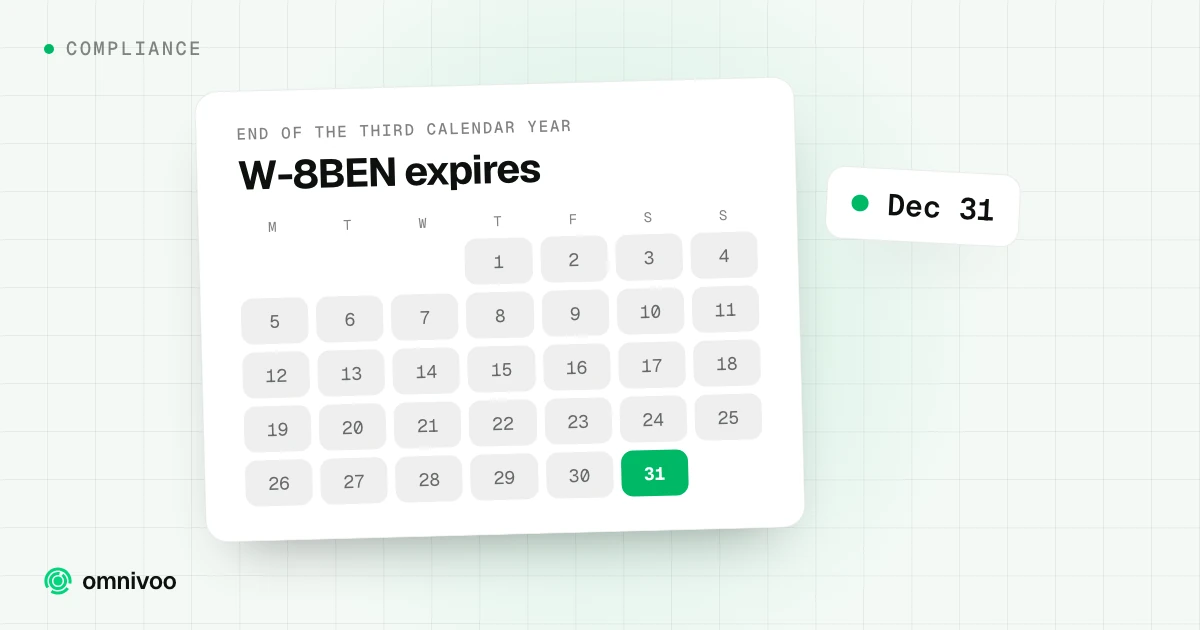
A form with an expiry date
A US company collects a Form W-8BEN from a foreign contractor, files it, and treats the relationship as documented. That is correct, right up to the point the form goes stale. The W-8BEN is not a permanent record. It has a built-in expiry date, and it can also stop being valid earlier than that date if the contractor’s situation changes.
When the form lapses, the consequences are not cosmetic. The payer can no longer rely on it, and the payment can fall back to default withholding rules. This guide gives the verified validity rule with the IRS wording attached, explains what happens when a form lapses, and lays out a practical way to track re-collection so you are never paying against an expired form.
A quick note before we start. This is general information, not tax or legal advice. Withholding and reporting outcomes turn on the facts of your situation, so confirm the specifics with a qualified tax professional before you pay.
What the IRS actually says about validity
The rule comes straight from the IRS Instructions for Form W-8BEN, under the period-of-validity heading:
“Generally, a Form W-8BEN will remain in effect for purposes of establishing foreign status for a period starting on the date the form is signed and ending on the last day of the third succeeding calendar year, unless a change in circumstances makes any information on the form incorrect.”
Two parts matter here. The first is the clock. Validity starts on the date the form is signed and runs to the last day of the third succeeding calendar year. The IRS gives a worked example in the same instructions: a form signed September 30, 2015 remains valid through December 31, 2018. Apply that to a current form. A W-8BEN signed any time in 2026 generally expires on December 31, 2029. The day and month of signing do not change the expiry. What matters is the calendar year, then three full calendar years after it, ending on December 31.
The second part is the escape clause at the end of the sentence: “unless a change in circumstances makes any information on the form incorrect.” The three-year window is a ceiling, not a guarantee. A change in the contractor’s situation can end the form’s validity well before the third year is out.
The change-in-circumstances rule
A change in circumstances is the second way a W-8BEN dies, and it puts an obligation on the contractor. The IRS Instructions for Form W-8BEN state:
“If a change in circumstances makes any information on the Form W-8BEN you have submitted incorrect, you must notify the withholding agent, payer, or FFI with which you hold an account within 30 days of the change in circumstances and you must file a new Form W-8BEN or other appropriate form.”
So the contractor has 30 days from the change to notify you and submit a fresh form. The IRS does not leave “change in circumstances” abstract. It names specific triggers in the same instructions:
- A change of address to an address in the United States is a change in circumstances.
- A move to the United States, or outside the country where the contractor has been claiming treaty benefits, is a change in circumstances.
- Becoming a US citizen or resident alien is a change in circumstances.
Each of these can knock out the foreign-status claim, the treaty claim, or both. A contractor who moves to a US address is no longer presenting a clean foreign-person picture, and a contractor who becomes a US person is outside the W-8BEN regime entirely. The form on file is now incorrect, and the IRS rule requires a new one inside 30 days.
The catch is that this rule depends on the contractor acting. You should not assume every contractor will remember to flag a move or a citizenship change inside a month. That is exactly why your own monitoring matters, which we get to below.
What happens when a W-8BEN lapses
Here is the part that makes expiry an operational risk rather than a paperwork footnote. Once a form is no longer valid, you cannot rely on it, and the payment falls back to the default rules.
The IRS Instructions for Form W-8BEN state the consequence plainly:
“If you do not provide this form, the withholding agent may have to withhold at the 30% rate (under chapters 3 and 4), backup withholding rate, or the rate applicable under section 1446.”
The instructions repeat the point for a form that is requested but not provided, noting that failure to provide a Form W-8BEN when requested may lead to withholding at the foreign-person withholding rate of 30 percent or the backup withholding rate under section 3406.
Translate that into the contractor relationship. A valid W-8BEN is what lets you treat a payment as foreign-person income and, where it applies, claim a reduced treaty rate. Without a valid form, the payer is back to the default position for US-source income, which the IRS NRA withholding regime sets at 30 percent before any treaty relief. A lapsed form can therefore push a payment that would have been withheld at a reduced treaty rate, or not at all, back into the 30 percent bracket, or into backup withholding. The treaty rate is not lost forever, but you cannot apply it on a stale form, and unwinding over-withholding later is far more work than collecting a fresh form on time.
A re-collection checklist
The fix is process, not law. You already know the two ways a form dies, so build a system that catches both before a payment goes out against an expired form.
- Diarize the expiry date at the moment you collect. Record the signing date and compute the expiry as December 31 of the third succeeding calendar year. A form signed in 2026 expires December 31, 2029. Set a reminder ahead of that date, not on it.
- Re-collect before the deadline, not after. Reach out for a fresh W-8BEN in the final quarter before expiry so a valid form is always on file when you pay. Never let a payment run against a form that has already lapsed.
- Watch for changes of address. A contractor’s address moving to the United States is a named change in circumstances. Flag any address update in your records for review, because a US address can break the foreign-status claim regardless of where the contractor actually works.
- Watch for changes in country and treaty claims. A move out of the treaty country the contractor claimed benefits from is a change in circumstances. If a contractor relocates, treat the treaty position as needing re-confirmation on a new form.
- Watch for citizenship and residency changes. Becoming a US citizen or resident alien takes the contractor out of the W-8BEN regime. Capture this in onboarding updates and annual confirmations.
- Remind contractors of their 30-day duty. The IRS puts the notification obligation on the person who signed the form. Make that expectation explicit in your contractor terms so the 30-day clock is understood on both sides.
- Keep the prior forms. Do not discard a superseded W-8BEN. The earlier form documents the period it covered, and your file should show a continuous, valid form for every payment date.
To work the underlying collection steps end to end, run our W-8BEN collection checklist before your next payment. It is free, instant, and walks the steps with the IRS citations attached.
The longer-validity exception
One caveat keeps the three-year rule honest. The IRS Instructions for Form W-8BEN note that under certain conditions a Form W-8BEN will remain in effect indefinitely until a change of circumstances occurs, and they cross-reference the Treasury regulations for the exact conditions rather than spelling them out in the instructions themselves.
Treat the three-year window as your planning default. It is the general case and the safe one to build your reminders around. If a particular form might qualify for indefinite validity, confirm that against the cited regulations for that specific situation rather than assuming it. Planning for the shorter, certain period and re-collecting on schedule never causes a withholding problem. Assuming a longer period that does not apply can.
When a platform handles it for you
A founder paying one foreign contractor can put a single reminder on a calendar. A US team paying contractors across several countries is tracking dozens of signing dates, dozens of expiry dates, address changes, citizenship changes, and treaty positions at once, and that is where manual tracking starts to leak. One missed expiry can flip a payment into 30 percent withholding.
According to the Omnivoo Contract Management page, the product collects the right tax form, runs the KYC, drafts and manages the contract, and pays contractors in 220+ countries and territories, end to end, for $29 per contractor per month. The same page states that transaction fees are passed through at cost, with competitive FX and no fee for contractors, cancel anytime.
Want the answer for your specific setup? See how Omnivoo Contract Management handles foreign contractors end to end, or talk to our team.