
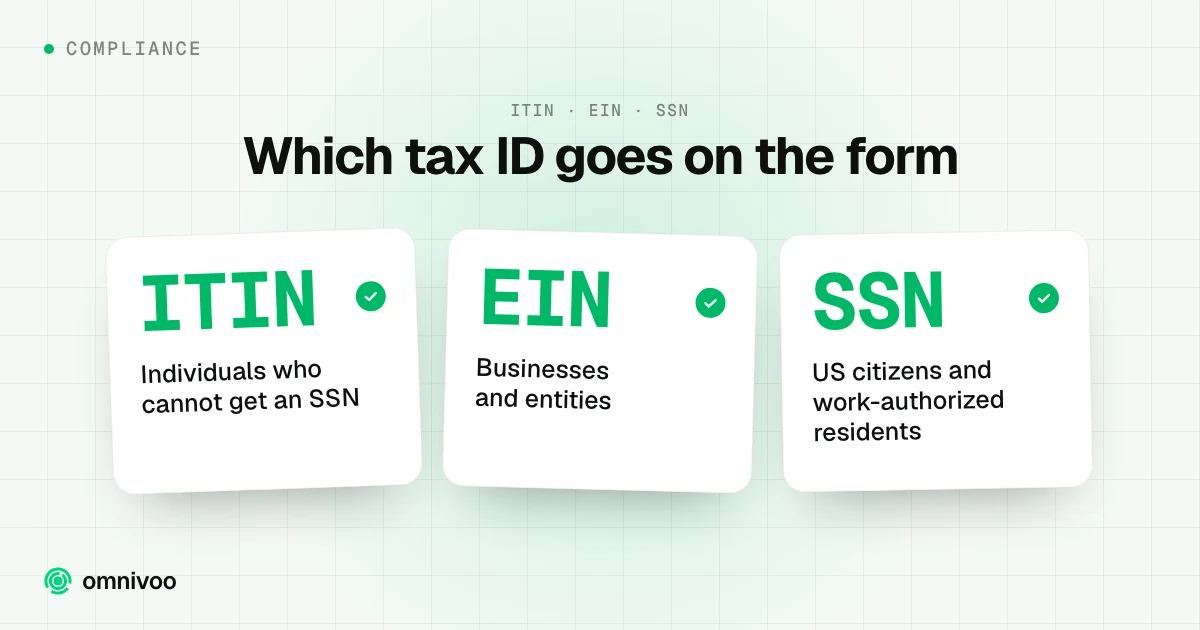
One decision, two questions
A US company collects a tax form from every contractor it pays, and on that form sits a taxpayer identification number. Which number belongs there is not a guess. It is decided by two questions asked in order.
First, is the contractor a US person or a foreign person? That decides the form. Second, is the contractor an individual or a business? That decides which tax ID goes on the form.
Get those two answers and the rest is mechanical. This guide walks the four combinations they produce, with the IRS citations attached, and a table you can map a real contractor onto in seconds. A quick note before we start. This is general information, not tax or legal advice. The right form and number turn on the facts of a specific contractor relationship, so confirm the specifics with a qualified tax professional before you pay.
The three numbers
The IRS recognizes several taxpayer identification numbers, but contractor work involves three of them. They are not interchangeable, and each is tied to a different kind of taxpayer.
The IRS Taxpayer Identification Numbers (TIN) page is explicit about who issues each one:
“A Social Security number (SSN) is issued by the SSA whereas all other TINs are issued by the IRS.”
SSN, the Social Security Number. Issued by the Social Security Administration to individuals. For a US contractor working as a person, this is the default tax ID.
EIN, the Employer Identification Number. The same TIN page states the EIN “is also known as a federal tax identification number, and is used to identify a business entity.” When the payee is a business, the EIN is its number.
ITIN, the Individual Taxpayer Identification Number. The TIN page describes it as “a tax processing number only available for certain nonresident and resident aliens, their spouses, and dependents who cannot get a Social Security Number (SSN). It is a 9-digit number.” For a foreign individual contractor, the ITIN is often the piece that unlocks a treaty rate. We cover it in depth in our ITIN glossary entry.
US contractors: Form W-9
A US person, individual or business, gives the payer a Form W-9. The IRS About Form W-9 page states the purpose plainly:
“Use Form W-9 to provide your correct Taxpayer Identification Number (TIN) to the person who is required to file an information return with the IRS”
The W-9 is a US-person form. Its certification has the signer attest, under penalties of perjury, that they are “a U.S. citizen or other U.S. person.” A foreign person cannot sign that, which is why the W-9 is never the right form for a foreign contractor. That split is the whole reason the two paths exist.
Inside the W-9, the number depends on what kind of US person is signing. The current Form W-9 (Rev. March 2024) sets it out in Part I:
“For individuals, this is generally your social security number (SSN). However, for a resident alien, sole proprietor, or disregarded entity, see the instructions for Part I, later. For other entities, it is your employer identification number (EIN).”
Two outcomes fall out of that sentence.
A US individual contractor reports their SSN. A freelancer working as a person, with no business wrapped around the work, puts their Social Security Number on the W-9. That is the default the form names first.
A US individual who runs the work through a business can report an EIN. A sole proprietor or single-member LLC owner has a choice, and the W-9 points them to the Part I instructions for which number to use. Many use an EIN to keep their SSN off invoices and forms.
A US business entity reports its EIN. A corporation, partnership, or multi-member LLC is one of the “other entities” the W-9 names, and its number is the EIN, the number that exists to identify a business entity. See our EIN glossary entry for what the number is and how a business obtains one.
Foreign contractors: the W-8 forms
A foreign person never files a W-9. They file a form in the W-8 series, and which one depends on whether they are a person or a company.
A foreign individual files Form W-8BEN. The IRS Form W-8BEN instructions say you give the form to the withholding agent “if you are a nonresident alien who is the beneficial owner of an amount subject to withholding.” The form carries two tax ID fields, and which one a contractor fills matters.
Line 6 is for the foreign tax ID. The W-8BEN instructions tell the contractor to “provide on line 6a the foreign tax identifying number (FTIN) issued to you by your jurisdiction of tax residence,” subject to certain exceptions. So the home-country tax number is the baseline identifier on the form.
Line 5 is for the US TIN, an SSN or an ITIN, and it is the field that drives treaty claims. The instructions state:
“If claiming treaty benefits, you are generally required to provide an ITIN if you do not provide a tax identifying number issued to you by your jurisdiction of tax residence on line 6.”
In other words, a foreign individual who wants the reduced treaty rate needs either a foreign TIN on line 6 or a US ITIN on line 5. Leave both blank while claiming a treaty rate and the payer generally cannot honor it. We walk the documentation steps in the W-8BEN collection checklist.
A foreign business entity files Form W-8BEN-E. The W-8BEN is for individuals only. The instructions are direct that an entity should not use it:
“You are a foreign entity documenting your foreign status, documenting your chapter 4 status, or claiming treaty benefits. Instead, use Form W-8BEN-E.”
A foreign company reports its identifying numbers on the W-8BEN-E, not the W-8BEN. The “-E” stands for entity, and it is the right form whenever the foreign payee is anything other than a single human being.
Decision table
| Payee type | Form | Tax ID reported |
|---|---|---|
| US individual contractor | Form W-9 | SSN, or an EIN if they operate as a business |
| US business entity | Form W-9 | EIN |
| Foreign individual | Form W-8BEN | Foreign TIN on line 6, plus a US ITIN on line 5 when needed for a treaty rate |
| Foreign business entity | Form W-8BEN-E | Reported on the W-8BEN-E, not the W-8BEN |
Two patterns hold across the whole table. Residence picks the form, US persons on the W-9 and foreign persons on a W-8. And the person-versus-business split picks the number, individuals lean on the SSN or ITIN while businesses use the EIN. For background on the family of numbers as a whole, see the taxpayer identification number glossary entry.
The mistakes that cause most rework
Most form errors come from mixing the two questions, asking about the number before settling residence, or assuming an individual contractor cannot have a business identifier.
Putting an SSN on a foreign contractor’s form. A foreign individual has no SSN to give, and the W-9 is the wrong form for them entirely. Their US tax ID, when they need one, is an ITIN entered on line 5 of the W-8BEN.
Treating every individual as an SSN-only payee. A US sole proprietor can report an EIN instead of an SSN, and many prefer to. The W-9 sends sole proprietors and single-member LLCs to the Part I instructions for the choice, so refusing an EIN from an individual who has one is not required by the form.
Sending a foreign company a W-8BEN. The W-8BEN is individuals only. A foreign company belongs on the W-8BEN-E. Collecting the wrong one means re-collecting it later, often after a payment has already gone out.
A quick decision path
Two questions, in order, for any contractor you are about to pay:
- Is the contractor a US person or a foreign person? US persons file Form W-9. Foreign persons file a W-8 form, never a W-9, because the W-9 certifies US person status.
- Is the contractor an individual or a business? A US individual reports an SSN, or an EIN if they operate as a business. A US business reports its EIN. A foreign individual reports a foreign TIN on line 6 of Form W-8BEN, plus a US ITIN on line 5 when a treaty claim needs one. A foreign business reports its numbers on Form W-8BEN-E.
Run those two and you have the form and the tax ID for almost every contractor relationship.
How this connects to the source-of-income question
The form and the tax ID are the documentation layer. They sit on top of a separate question, whether a payment owes US tax at all, and that turns on where the work is performed. We cover that test in US-source vs foreign-source contractor income. The W-8BEN documents a foreign contractor’s status, and the source-of-income rule then decides what, if anything, gets withheld and reported. Collect the right form first, then apply the source rule.
When a platform handles it for you
A US founder paying one or two contractors can collect the right form by hand. A US team paying across several countries is tracking W-9s, W-8BEN and W-8BEN-E forms, SSNs, EINs, ITINs, foreign TINs, and treaty positions at once, and that is where the manual approach starts to leak.
Omnivoo Contract Management handles it for $29 per contractor per month. We collect the right tax form for each contractor, run the KYC, draft and manage the contract, and pay your contractors in 220+ countries and territories, end to end. Transaction fees are passed through at cost, with competitive FX and no fee for contractors, cancel anytime.
Want the answer for your specific setup? See how Omnivoo Contract Management handles contractor tax forms end to end, or talk to our team.