
Two forms that travel together
If you pay foreign persons US-source income, two IRS forms with nearly identical names land on your desk: Form 1042 and Form 1042-S. The names suggest one is a version of the other. They are not. They do different jobs, and a payer with reportable payments usually files both.
The short version is this. Form 1042 is the single annual return where you report and reconcile all the tax you withheld on US-source income paid to foreign persons. Form 1042-S is the per-recipient statement that reports one foreign payee’s US-source income and the tax withheld on it. One is the summary. The other is the detail. The detail forms roll up into the summary.
This guide gives the verified difference with the IRS citations attached, a comparison table, and the one rule that decides whether you owe either form at all. A quick note before we start. This is general information, not tax or legal advice. Withholding and reporting outcomes turn on the facts of your situation, so confirm the specifics with a qualified tax professional before you file.
What Form 1042 is
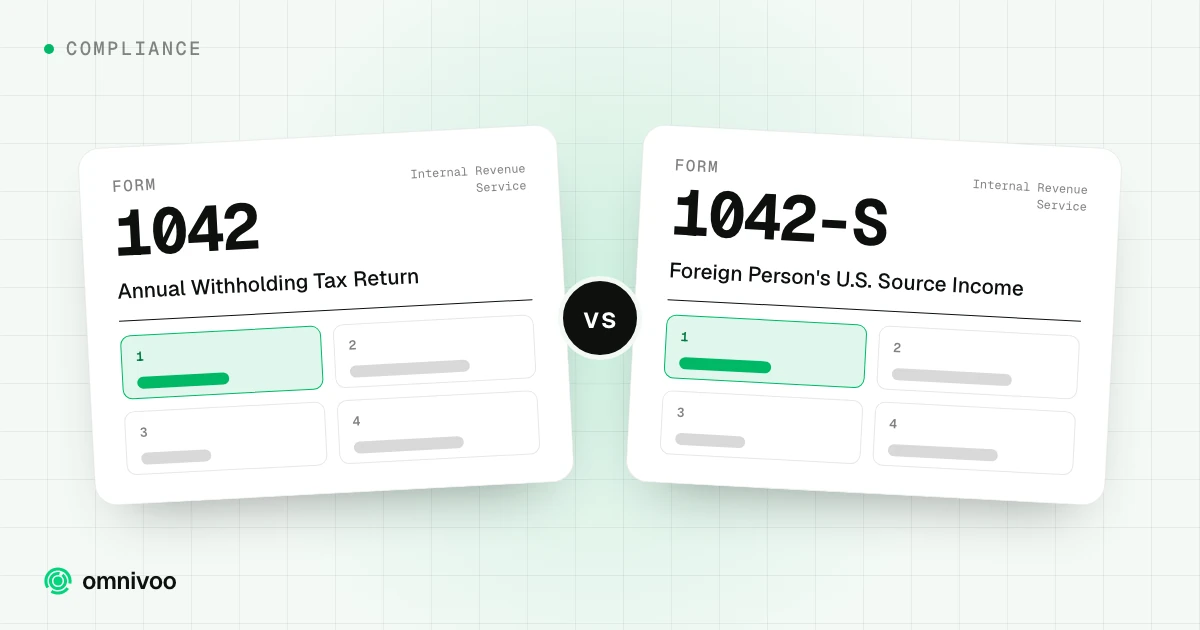
Form 1042 is the withholding agent’s annual return. Its official title, per the IRS About Form 1042 page, is “Annual Withholding Tax Return for U.S. Source Income of Foreign Persons.”
The same IRS page states that you use Form 1042 to report:
“The tax withheld under chapter 3 on certain income of foreign persons, including nonresident aliens, foreign partnerships, foreign corporations, foreign estates, and foreign trusts.”
It also reports tax withheld under chapter 4 on withholdable payments, tax due under section 5000C, and, importantly, “payments reported on Form 1042-S.” That last item is the link between the two forms. The 1042 is where the per-recipient 1042-S amounts get summarized for the year.
So Form 1042 is filed once per year, by the payer, with the IRS only. The contractor never sees it. Think of it as the cover sheet that tells the IRS how much tax you withheld in total and reconciles it against what you actually deposited.
What Form 1042-S is
Form 1042-S is the recipient-level statement. Its official title, per the IRS About Form 1042-S page, is “Foreign Person’s U.S. Source Income Subject to Withholding.”
You file a separate Form 1042-S for each foreign person you paid reportable US-source income to, reporting that recipient’s income and the amounts withheld. Because it names a specific payee, it works like a 1099 does for US payees: one copy is furnished to the foreign recipient and another is filed with the IRS. The 1042 has no such recipient copy.
The naming makes the relationship clear once you read both titles together. The 1042 is the “Annual Withholding Tax Return,” the yearly summary. The 1042-S is the “Foreign Person’s U.S. Source Income,” the per-person detail. The “S” form is the statement, and the statements feed the return.
Side by side
| Form 1042 | Form 1042-S | |
|---|---|---|
| Official title | Annual Withholding Tax Return for U.S. Source Income of Foreign Persons | Foreign Person’s U.S. Source Income Subject to Withholding |
| What it reports | Total tax withheld under chapters 3 and 4 on US-source income paid to foreign persons | One foreign recipient’s US-source income and the tax withheld on it |
| Level | Summary, one return for the whole year | Detail, one statement per recipient |
| How many you file | One per year per withholding agent | One for each foreign recipient |
| Who receives a copy | IRS only | The foreign recipient and the IRS |
| Relationship | The 1042-S amounts are reported on the 1042 | Each 1042-S feeds into the single 1042 |
The pattern to hold onto: many 1042-S forms, one 1042. The totals on your 1042-S forms should reconcile to the single 1042 you file for the year.
Do you file both?
If you have reportable US-source payments to foreign persons, the usual answer is yes, both. You issue a Form 1042-S to each foreign recipient and file copies with the IRS, then file a single Form 1042 for the year that includes those payments. The IRS About Form 1042 page lists “payments reported on Form 1042-S” as one of the items reported on Form 1042, which is exactly why the two move together.
They are not interchangeable. You cannot file a 1042 in place of the recipient statements, and a stack of 1042-S forms does not stand in for the annual return. Each does a job the other does not. The 1042-S tells each recipient and the IRS what that recipient earned and what was withheld. The 1042 tells the IRS your total for the year and reconciles it to your deposits.
The rule that can mean you file neither
Before you reach for either form, ask one question: was this income even US-source? For personal services, the source of the income is decided by where the work is physically performed, not where your company sits or where you paid from. Both Form 1042 and Form 1042-S are about US-source income paid to foreign persons, so foreign-source income falls outside both.
The IRS Foreign Source Income, Form 1042-S Reporting Not Required page states:
“Foreign source income (non-U.S. source income) paid to a nonresident alien is normally not subject to U.S. tax under either chapter 3 or 4. Income from sources outside of the United States is exempt from NRA withholding under Internal Revenue Code Section 1441(a). It is normally not required to be reported on an information return.”
So a foreign contractor performing services entirely outside the US earns foreign-source income. That income is generally exempt from NRA withholding under Internal Revenue Code section 1441(a), and it is generally not required on an information return. No withholding to report means nothing flows onto a Form 1042-S, and with no 1042-S amounts there is generally nothing to roll up onto a Form 1042. For that common case, both forms simply do not apply.
You still collect and keep a valid Form W-8BEN to document the contractor’s foreign status. That form is your evidence that the income was foreign-source. It is not filed with the IRS, and it does not turn into either a 1042 or a 1042-S.
When the forms do come back into play
The picture changes the moment a foreign contractor performs work inside the US. Work physically done on US soil is US-source income, even for a foreign national who normally lives abroad. US-source FDAP income paid to a foreign person is the trigger for the withholding regime, which means a Form 1042-S for that recipient and the payer’s annual Form 1042 both come back into the picture, with NRA withholding applied at the statutory rate unless a treaty reduces it.
If a contractor splits time, doing most of the work abroad and some inside the US, only the US-source portion is reportable. The foreign-source portion stays outside both forms. So the day-to-day question is rarely “1042 or 1042-S,” because if you owe one you usually owe the other. The real question is whether any of the income was US-source in the first place.
A quick decision path
Three questions, in order, for any foreign person you pay:
- Where did the contractor physically perform the work? All outside the US generally means foreign-source, so generally no 1042 and no 1042-S. Any work inside the US means at least part is US-source and reportable.
- Is there US-source income with reportable withholding? If yes, you issue a Form 1042-S to that recipient and file it with the IRS.
- Did you withhold US-source amounts for the year? Roll the 1042-S totals into the single Form 1042 you file annually, and reconcile it to your deposits.
Run those three and the “1042 vs 1042-S” question answers itself, because the two forms either both apply or both do not.
When a platform handles it for you
A US founder paying one foreign contractor who works abroad can confirm the income is foreign-source, keep a W-8BEN, and file nothing. A US team paying contractors across several countries is tracking source-of-income calls, US-day counts, withholding, recipient statements, and an annual reconciliation, and that is where the manual approach starts to leak.
Omnivoo Contract Management handles it for $29 per contractor per month. We collect the right tax form, run the KYC, draft and manage the contract, and pay your contractors in 220+ countries and territories, end to end. Transaction fees are passed through at cost, with competitive FX and no fee for contractors, cancel anytime.
Want the answer for your specific setup? See how Omnivoo Contract Management handles foreign contractors end to end, or talk to our team.