
COMPARISON
Best Contractor Management Platforms for Global Teams in 2026
13 contractor management platforms for global teams compared on price, contracts, tax forms, payouts and what your contractor pays. Verified October 2026.
Reviewed by Rohan Sasne on Mar 19, 2026
An accountable plan is an employer reimbursement or allowance arrangement that meets three IRS conditions in Publication 463: the expense has a business connection, the employee adequately accounts for it within a reasonable period of time, and any excess reimbursement is returned within a reasonable period of time. Reimbursements paid under such a plan are not treated as taxable wages.
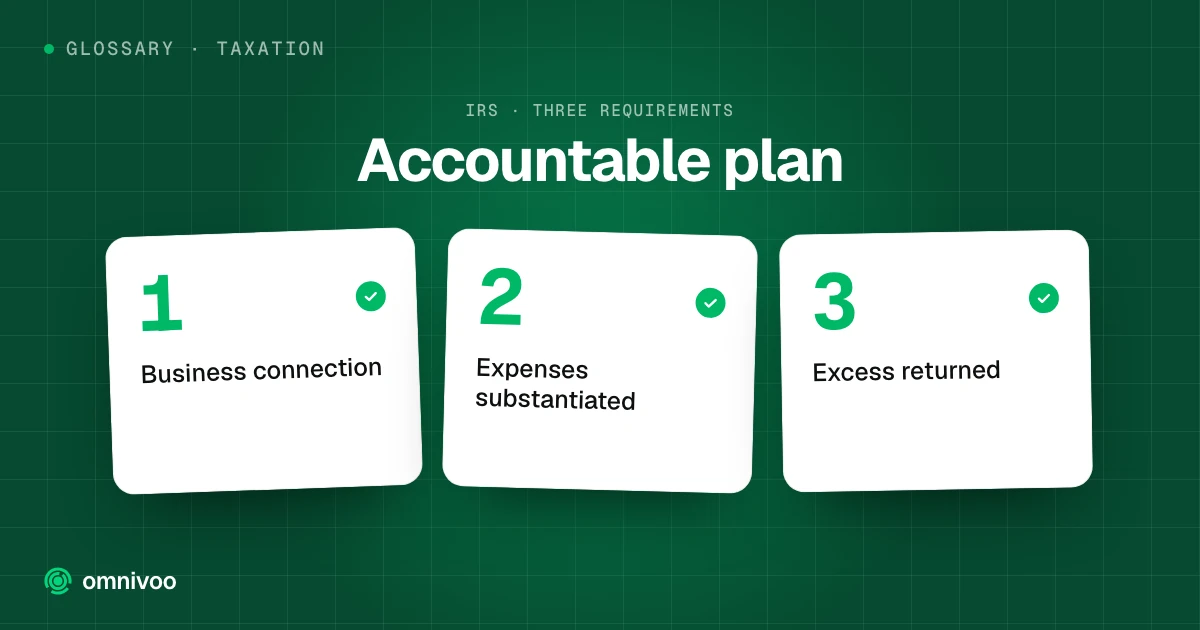
An accountable plan is an expense reimbursement or allowance arrangement that lets an employer pay an employee back for business costs without that money becoming taxable wages. The rules sit in IRS Publication 463, in the Accountable Plans section under Reimbursements. When the arrangement meets the IRS conditions, the reimbursement is excluded from the employee’s taxable wages and is not subject to income tax withholding, so it does not appear as compensation on the Form W-2.
IRS Publication 463 states that a reimbursement or allowance arrangement must satisfy all three of the following to be an accountable plan:
All three must hold. If even one fails, Publication 463 treats the arrangement as a nonaccountable plan, and the payments become taxable wages reported on Form W-2 and subject to withholding.
The accountable plan is the difference between a tax-free reimbursement and additional taxable pay. Under an accountable plan, the employee is made whole for a business cost and the employer takes the deduction, with no payroll tax or income tax consequence on the reimbursement. Under a nonaccountable plan, the same dollars run through payroll as wages, which raises the employee’s tax and the employer’s payroll tax cost. For that reason, employers that want reimbursements to stay tax-free document expenses, set a substantiation deadline, and require return of any unspent advance.
The IRS also notes that failing to return excess reimbursement within a reasonable period of time causes the entire reimbursement to be treated as paid under a nonaccountable plan, not just the excess. Timing and substantiation are not optional details. They decide the tax result.
An accountable plan is primarily an employer and employee idea. It governs how a business reimburses its own workers. An independent contractor is not an employee, so the contractor does not receive accountable plan reimbursements. Instead, the contractor folds any reimbursed expense into their own business accounting. Amounts a client pays toward the contractor’s costs are part of the contractor’s gross income, and the contractor separately deducts the underlying business expenses on their own return. The accountable plan rules in Publication 463 simply do not reach that relationship.
Omnivoo Contract Management records reimbursable costs you pass through to a contractor against the payment, so the underlying expenses and the amounts paid are documented together for clean year-end records.
Collect W-8BEN and W-9, sign country-aware contracts, and pay contractors in 220+ countries and territories.
A gross-up is an upward adjustment to a payment so the recipient nets a target amount after taxes or fees are deducted, with the payer absorbing the added cost. The grossed-up figure is found by dividing the desired net by one minus the applicable rate.
Supplemental wages are payments an employer makes to an employee in addition to regular wages, such as bonuses, commissions, overtime pay, and severance, and they carry their own federal income tax withholding methods under IRS Publication 15. The optional flat rate is 22 percent, rising to a mandatory 37 percent on supplemental wages over 1 million dollars paid to an employee in a calendar year.
Collect the right tax form before you pay, sign a country-aware contract, and pay contractors in 220+ countries and territories. $29 per contractor per month.
Get startedFull details in our Terms of Service →