
Why this guide exists
Canada is the easiest international hiring lane for most US companies. Shared time zones, a common business language, strong engineering and design talent, and a tax relationship that is one of the most settled in the world. A US startup hiring its first Canadian contractor often assumes the process is identical to hiring a US contractor, then gets tripped up by one detail: a Canadian contractor who is not a US person never gets a 1099-NEC. They get a W-8BEN.
This guide covers the full stack for a US company paying contractors in Canada. We look at the US side (W-8BEN, source of income, the treaty for edge cases), the Canada side (CRA business number, GST/HST, CPP), and the payment rail. By the end you should know exactly what to ask your contractor for and what each document is doing in the chain.
If you want to skip the assembly and let a platform run the whole stack, Omnivoo Contract Management handles SOW drafting, W-8BEN collection, invoice capture, and CAD or USD payouts for $29 per contractor per month.
US side: what you need to do as the payer
Step 1. Collect a W-8BEN before the first payment
The first action is non-negotiable. Before any invoice is paid, the contractor must complete Form W-8BEN and return it to you. The form certifies the contractor is the beneficial owner of the income, is a tax resident of Canada, and is not a US person.
This is the single most common mistake US companies make with Canadian contractors. Because Canada feels so close to the US, founders reach for the same Form 1099-NEC they use for US contractors. That is wrong. A 1099-NEC is for US persons. A Canadian contractor who is not a US person provides a W-8BEN instead, and you do not file a 1099-NEC for them.
The W-8BEN is valid for three calendar years after signature and must be refreshed when it expires or when a relevant fact changes. If your contractor operates through an incorporated Canadian company (a corporation rather than a sole proprietorship), the form is W-8BEN-E, the entity equivalent. Before you pay, run through our W-8BEN collection checklist to make sure every field is complete.
Step 2. Confirm the work is performed in Canada
Under IRS source of income rules for personal services, services income is sourced to the place where the services are physically performed. If your Canadian contractor does the work entirely from Toronto, Vancouver, Montreal, or Calgary, the income is Canadian source income from the US perspective.
The practical takeaway: no withholding, no 1042-S, no 1099-NEC. You keep the W-8BEN, the SOW, the invoice, and the payment receipt as the documentation packet.
If the contractor crosses the border for an onsite sprint or quarterly planning in the US, the days physically worked inside the US are US source days. Those days have to be allocated and may trigger withholding plus a 1042-S. Because the US-Canada border is so easy to cross, many US companies that hire heavily in Canada keep a simple onsite-days log to stay clean.
Step 3. Know the treaty for the edge cases
The US-Canada income tax treaty was signed in 1980 and is in force. It has been amended by five protocols, the most recent of which (the 2007 protocol) generally took effect from 2009. The IRS lists the convention and its technical explanations on its Canada tax treaty documents page, and Publication 597 summarises the treaty for taxpayers.
The treaty matters only when your payment generates US source income. For services performed in Canada there is no US source income, so the treaty does not change the analysis. Where it comes into play is the onsite-days scenario above, or where a SOW characterises part of the fee as a royalty for transferred intellectual property. In those cases the contractor uses Form 8233 (for services) or W-8BEN (for other income types) to claim the relevant treaty article.
For most pure services engagements (development, design, marketing, customer success), the cleanest practice is to draft the SOW as a pure services agreement with full IP assignment for value already included in the fee, which avoids splitting the fee into a royalty component.
Canada side: what your contractor handles
You as the US payer are not in scope for most Canadian taxes. The Canadian contractor is. But understanding the landscape helps you have an informed conversation about invoice format, GST/HST treatment, and how the contractor is set up.
Sole proprietor or incorporated, and the CRA business number
A Canadian freelancer typically operates in one of two ways: as a sole proprietor (reporting business income on their personal T1 return) or through an incorporated company (a corporation that files its own T2 return). Senior contractors often incorporate for tax planning and liability reasons. The form you collect depends on which one applies (W-8BEN for the individual, W-8BEN-E for the corporation).
When a contractor needs to register for GST/HST, the Canada Revenue Agency (CRA) assigns them a business number (BN), a nine-digit identifier used across CRA program accounts. You do not need the BN to pay them. You only need a valid invoice.
GST/HST and exported services
Taxable supplies made in Canada are generally subject to GST at the federal rate of 5 percent, with participating provinces adding a provincial component so the combined Harmonized Sales Tax (HST) is higher in those provinces.
A contractor must register for a GST/HST account once their worldwide taxable sales exceed the 30,000 dollar small-supplier threshold over four consecutive calendar quarters. Below that threshold they can operate without registering.
Here is the part that matters for you. Services exported to a non-resident recipient are commonly zero-rated, meaning the contractor charges GST/HST at 0 percent. The CRA places the burden on the supplier to determine whether the supply is zero-rated and to keep evidence supporting that determination. As the US payer, you do not pay or recover GST/HST. The cleanest signal that the contractor has handled this correctly is an invoice that shows the service as zero-rated rather than charging you 5 percent or more.
CPP and Canadian income tax
A self-employed Canadian contractor pays into the Canada Pension Plan (CPP) on their net self-employment earnings, and pays Canadian income tax at the federal and provincial rates that apply to them. These are the contractor’s own obligations. You as the US client do not contribute to CPP, do not withhold Canadian tax, and have no CPP or Canadian payroll reporting obligation.
Interac, EFT, and Canadian banking
Canada’s domestic payment rails are EFT (Electronic Funds Transfer, the bank-to-bank ACH equivalent) and Interac e-Transfer, the near-instant rail Canadians use to send money between accounts. Once your CAD payment lands in the contractor’s Canadian bank account, those are the rails that move it domestically. Payment platforms that support Canada typically settle a USD-to-CAD payment by depositing CAD into the contractor’s account, which is faster and cheaper than a SWIFT wire routed through correspondent banks.
The payment rail decision
There are four real options for paying a Canadian contractor from a US bank account.
| Rail | Typical FX margin | Speed | Notes |
|---|---|---|---|
| US bank SWIFT wire | 2 to 4 percent | 1 to 3 business days | Highest leakage, correspondent fees |
| Wise USD to CAD | ~0.4 to 0.7 percent | Same day to one day | Lands CAD via EFT or Interac |
| Payoneer USD to CAD | Tiered, lower at volume | One business day | Widely accepted |
| USD to a USD account the contractor holds | Low or none | Same day to one day | Useful if contractor banks in USD |
For most US companies paying one to ten Canadian contractors, Wise or Payoneer is the cleanest option. Because the corridor is so liquid, FX margins are low and settlement is fast. SWIFT remains a fallback for one-off larger payments where the percentage cost matters less. For a deeper view of where FX cost actually leaks, see our guide on FX margin in international contractor payments.
Misclassification risk in Canada
Canada does not decide worker status by the label on the contract. The CRA applies a substance test, set out in its Employee or Self-employed guide, that weighs the whole relationship: the level of control the payer has over the worker, whether the worker provides their own tools and equipment, whether the worker can subcontract or hire assistants, the degree of financial risk the worker takes, and the worker’s opportunity for profit. On top of the federal CRA analysis, each province runs its own employment standards regime, and provincial standards can pull a misclassified worker into employee entitlements.
If a contractor is reclassified as an employee, the consequences can include retroactive CPP and Employment Insurance contributions, vacation pay, and other employee entitlements under provincial law. The mitigations are the same as in other markets: a properly drafted services agreement that establishes the contractor relationship in substance, a legitimate scope tied to deliverables not time, evidence the contractor has other clients, and a documented review at the six and twelve month checkpoints.
For more depth on how to structure these contracts, see our guide on drafting an SOW for global contractors. The Omnivoo Contract Management SOW templates use a master service agreement plus statement of work structure with these protections baked in.
End-to-end workflow
Here is the clean version for a US company onboarding its first Canadian contractor.
- Send the contractor a services agreement that defines deliverables, payment, IP assignment, and termination.
- Collect a signed W-8BEN before any payment moves. Do not issue a 1099-NEC to a non-US person.
- Confirm whether the contractor is a sole proprietor or incorporated, and whether they are GST/HST registered (the invoice format differs slightly).
- Pick a payment rail (Wise, Payoneer, or comparable) and onboard the contractor’s payout details (Canadian account for EFT or Interac, or a USD account if they have one).
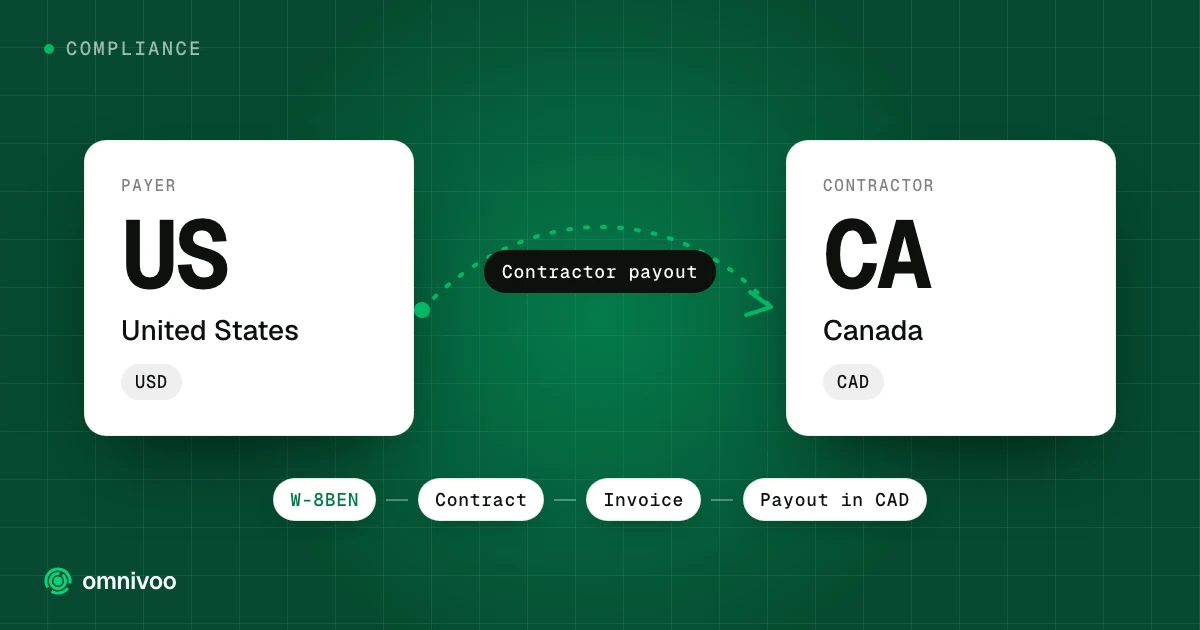
- Pay the invoice on schedule. Keep the W-8BEN, services agreement, invoice, and payment receipt together as a packet.
- Review the engagement quarterly for misclassification risk and refresh the W-8BEN every three years.
If you also handle non-Canadian contractors, the contractor management vs contractor of record comparison helps you pick the right product. For the broader framework, see our guide on how to pay international contractors from the US. If you pay contractors elsewhere in the Americas, see our guides on paying Mexico and Latin America contractors.
When a platform pays for itself
A US founder paying one Canadian contractor can do this manually. A US team paying five or more Canadian contractors faces enough W-8BEN refreshes, GST/HST treatment confirmations, and FX margin questions that a platform pays for itself within the first few months.
Omnivoo Contract Management is $29 per contractor per month. We draft the services agreement with Canada-specific IP and misclassification clauses, collect the W-8BEN (never a misapplied 1099-NEC), capture the invoice on every payment, run the FX payment through a CAD rail to avoid SWIFT leakage, and store the full packet for audit. Transaction fees are passed through at cost, with competitive FX and no fee for contractors, cancel anytime.
A simple sanity check
Three questions for every Canadian contractor relationship.
- Is there a signed W-8BEN on file (not a 1099-NEC) and is it less than three years old?
- Will all the work be performed in Canada for the foreseeable future?
- Are we paying through a rail that lands CAD via EFT or Interac and captures the invoice for every payment?
If yes to all three, you are in great shape on the US-Canada stack. The remaining work is misclassification hygiene over time.
Want to skip the assembly entirely? See how Omnivoo Contract Management handles Canadian contractors end to end, or talk to our team about your specific setup.