
The question every US founder asks first
You want to pay a developer in Lagos, a designer in Lisbon, or a writer in Manila. The first worry is almost always the same. Do I have to register a company over there before I can send them money?
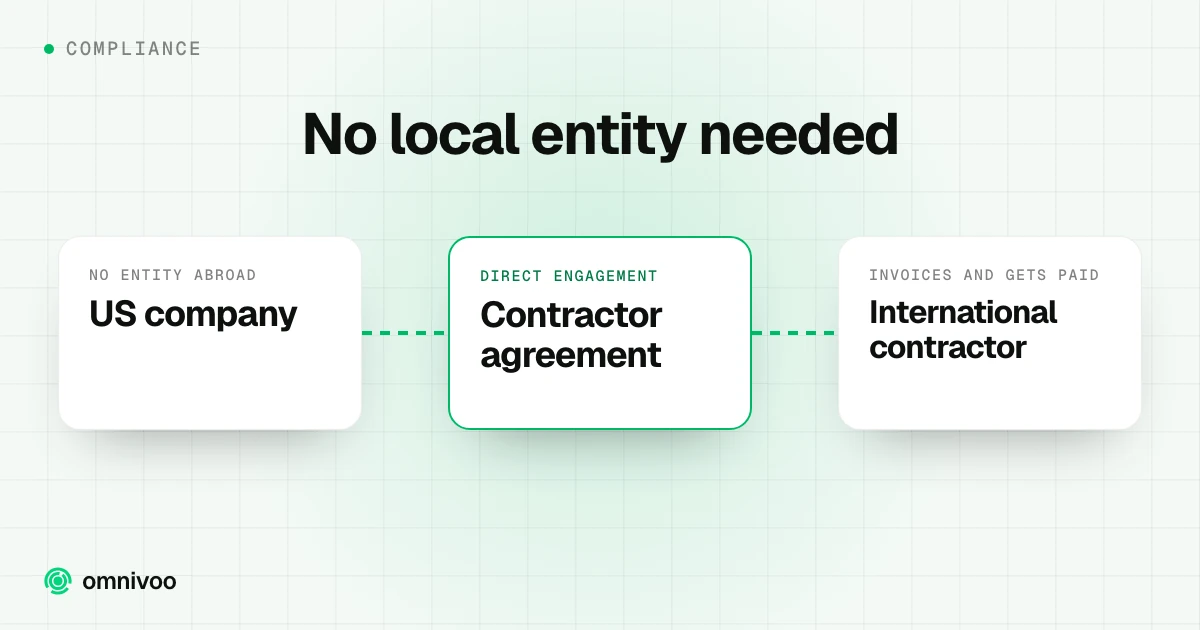
For an independent contractor, the answer is no. You do not need a legal entity in the contractor’s country to pay them. The reason is simple once you see it. A genuine independent contractor is a business, and you are buying a service from that business the same way you would buy from any foreign supplier. You do not open a subsidiary in Germany to buy software from a German vendor, and you do not need one to pay a German contractor either.
This guide walks the verified reason behind that, the three things you actually need, and the one line where this gets dangerous. A quick note before we start. This is general information, not tax or legal advice. Classification and tax outcomes turn on the facts of your situation, so confirm the specifics with a qualified professional before you pay.
Why no entity is needed for a contractor
The whole answer rests on what an independent contractor is. The IRS independent contractor defined page states it plainly:
“an individual is an independent contractor if the person for whom the services are performed has the right to control or direct only the result of the work and not what will be done and how it will be done.”
The same page describes who these people are:
“People such as doctors, dentists, veterinarians, lawyers, accountants, contractors, subcontractors, public stenographers, or auctioneers who are in an independent trade, business, or profession in which they offer their services to the general public are generally independent contractors.”
Read what that means for your foreign worker. They are in business for themselves. They offer their services to the public, not just to you. They decide how and when to do the work. Because they run their own business, they handle their own local obligations. They register themselves if their country requires it, they invoice you, and they pay their own income tax and social contributions where they live.
None of that is your job as the buyer. You are a customer paying an invoice. A customer does not need to incorporate in the seller’s country, and that is exactly why no foreign entity is required to pay a real contractor.
The three things you actually need
So if not an entity, what does it take? Three things, and only three.
A signed contractor agreement. A written independent contractor agreement that defines the scope, the deliverables, the payment terms, and that states the worker is independent and responsible for their own taxes. This is also your evidence of the relationship if anyone ever questions it.
A Form W-8BEN on file. Before you pay a foreign individual, collect a valid Form W-8BEN. It documents that the contractor is a foreign person and is your support for not treating the payment as that of a US person. Collect it before the first payment, not after.
A way to send the money. A payment method that can reach the contractor’s country in a currency they can receive. That is the operational piece, separate from the legal one.
That is the full set for a foreign contractor doing the work abroad. No incorporation on your side, no local registration, no payroll setup. To get the documentation right, work through the W-8BEN collection checklist before your next payment. It is free, instant, and walks the steps with the IRS citations attached.
The tax side: foreign work is foreign-source
There is a tax reason the no-entity path works cleanly too, and it is worth understanding so you do not over-withhold.
For personal services, the IRS sources income to where the work is physically performed. The source-of-income rule for personal services states:
“The place, where the personal services are performed, generally determines the source of the personal service income, regardless of where the contract was made, or the place of payment, or the residence of the payer.”
A contractor doing all their work from their home country is performing services outside the US, so the income is foreign-source. Foreign-source income paid to a foreign person is generally not subject to US tax or NRA withholding, which is why the W-8BEN documents the status rather than triggering a deduction. We cover the full source rule, including the case where a contractor performs some work inside the US, in US-source vs foreign-source contractor income.
The practical takeaway for the no-entity question: paying from a US bank account does not create a US tax presence in the contractor’s country, and buying a service from a foreign business does not, on its own, give your company a taxable footprint there. The footprint risk shows up when a worker starts to look like staff, which is the permanent establishment concern we return to below.
Where it flips: an employee is a different animal
Everything above holds for a contractor. It does not hold for an employee. This is the line that matters most, so it gets its own section.
An employee is defined by control and integration, the opposite of independence. The IRS independent contractor or employee page frames the test around three categories of evidence:
“Does the company control or have the right to control what the worker does and how the worker does his or her job?”
That is behavioral control. The page also asks whether “the business aspects of the worker’s job” are “controlled by the payer,” which is financial control, and whether there are “written contracts or employee type benefits,” which is the type of relationship. Its summary line:
“The keys are to look at the entire relationship and consider the extent of the right to direct and control the worker.”
If you control how and when the person works, set their hours, require exclusivity, give them a company email and a seat in your daily standup, and intend the relationship to run indefinitely, you are describing an employee, regardless of what the contract calls them.
To employ someone in their country, the contractor path does not work. You generally need one of two things. A local legal entity in that country, which means incorporating, registering for payroll, and running local employment compliance yourself. Or an Employer of Record, a company that already has an entity there and legally employs the person on your behalf while you direct the work. The EOR carries the local employment obligations so you do not have to open the entity. The trade-off between the two paths is exactly what we lay out in contractors vs EOR: when to use each.
The misclassification trap
Here is where the no-entity advantage turns into a liability if you push it too far.
The trap is treating someone who is functionally an employee as a contractor, specifically to avoid setting up an entity or an EOR. It is tempting. You skip the registration, you skip the payroll, you just send an invoice payment. But the classification is not yours to declare. The IRS control test, and the equivalent tests in the contractor’s own country, decide what the relationship is based on the facts, not the label on the agreement.
A long-term worker you direct day to day, who works only for you, who has set hours and no other clients, fails the independence test. The IRS standard, again, is that an independent contractor exists only where the payer controls “only the result of the work and not what will be done and how it will be done.” A controlled, exclusive, indefinite worker is the opposite of that.
If a tax authority reclassifies that person as an employee, the bill lands on you. Back taxes, unpaid social contributions, statutory benefits, and penalties, often in the contractor’s country where you have no entity and limited visibility. This is worker misclassification, and the longer the relationship runs under a contractor label that does not fit, the larger the exposure grows. The safest test is honest. If the person looks, works, and is treated like a member of your team, they probably are one, and the right answer is an entity or an EOR, not a contractor agreement.
A quick decision path
Three questions, in order, for any foreign worker you want to pay:
- Do they run their own business and control how the work gets done? If yes, they are a contractor. Collect a W-8BEN, sign an agreement, and pay them. No entity needed.
- Do you control what they do and how, set their hours, and expect exclusivity? If yes, they look like an employee. You need a local entity or an Employer of Record in their country.
- Are you tempted to call an employee a contractor to skip step 2? Stop. That is the misclassification trap, and the facts, not the contract, decide the outcome.
Run those three and you will know whether the no-entity contractor path is the right one or whether you need to employ the person properly.
How Omnivoo fits
For the contractor path, Omnivoo Contract Management handles the whole thing for $29 per contractor per month. We collect the right tax form, run the KYC, draft and manage the contract, and pay your contractors in 220+ countries and territories, end to end. Transaction fees are passed through at cost, with competitive FX and no fee for contractors, cancel anytime. No foreign entity required, because none is needed to pay a genuine contractor.
If the relationship is really employment, the contractor path is the wrong tool. Omnivoo’s Employer of Record offering is India-only today, so for India hires you can employ someone compliantly without your own Indian entity. For other countries, employment requires a local entity or an EOR with presence there.
Want the answer for your specific setup? See how Omnivoo Contract Management handles foreign contractors end to end, or talk to our team.
See also the broader guide on how to pay international contractors from the US.