
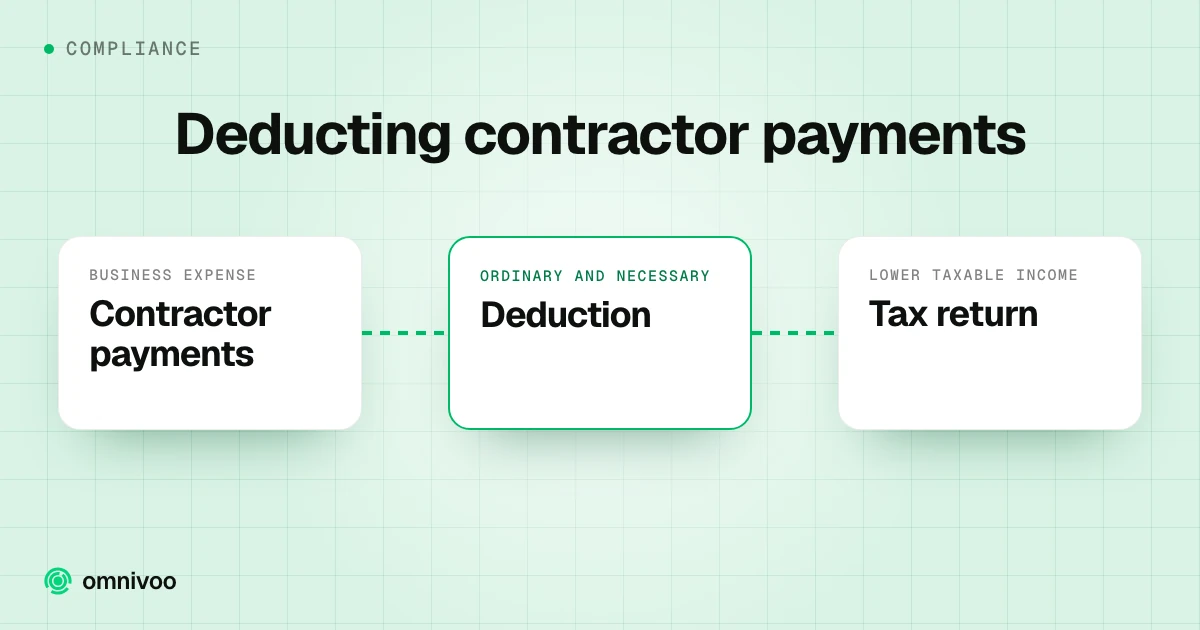
The short answer
A US company pays a contractor and wants to know one thing at tax time: can it write that payment off? In almost every normal case, the answer is yes. Money you pay a contractor for work done for your business is a business expense, and business expenses are deductible.
That single sentence carries the whole topic, but the details around it are where people get tripped up. The deduction itself rests on a specific IRS test. Where you report it depends on how your business is structured. And there is a separate, often confused obligation sitting next to the deduction: the information return you may have to file for the same payment. This guide walks all three with the IRS citations attached.
A quick note before we start. This is general information, not tax or legal advice. How a deduction lands on your return depends on the facts of your business, so confirm the specifics with a qualified tax professional before you file.
Why contractor payments are deductible
The deduction comes from the general rule the IRS applies to every business expense, not from any special contractor rule. To deduct anything as a business cost, it has to clear one bar. Per IRS Publication 535, Business Expenses:
“To be deductible, a business expense must be both ordinary and necessary. An ordinary expense is one that is common and accepted in your industry. A necessary expense is one that is helpful and appropriate for your trade or business. An expense does not have to be indispensable to be considered necessary.”
Read that against a contractor payment. Hiring a freelance designer, a contract developer, or an outside bookkeeper is common and accepted across most industries, so it is ordinary. It is helpful and appropriate to running the business, so it is necessary. A normal contractor fee for work done for your business clears both halves of the test, which is why it is deductible.
This is the same standard that lets you deduct rent, software, and professional fees. Contractor pay is not a special category. It is one more ordinary and necessary cost of doing business, and it is deducted on that basis.
Where a sole proprietor reports it
The deduction is real, but it has to land somewhere on your return. For a sole proprietor, that place is Schedule C.
The IRS About Schedule C (Form 1040) page describes the form as one used to “report income or loss from a business you operated or a profession you practiced as a sole proprietor.” Schedule C is where a one-owner business totals up its revenue, subtracts its expenses, and arrives at the profit or loss that flows onto the owner’s personal Form 1040. Contractor payments are one of those subtracted expenses.
There are two main lines where they show up.
Contract labor, line 11. This is the default home for most independent contractor payments. The Schedule C instructions describe line 11 this way:
“Contract labor includes payments to persons you do not treat as employees (for example, independent contractors) for services performed for your trade or business.”
That is the textbook contractor relationship. You paid someone who is not your employee to perform services for your business, so the fee goes on line 11.
Other expenses, Part V into line 27a. Not every payment to a contractor is contract labor in the line 11 sense. Some contractor costs belong elsewhere, and the Schedule C instructions are explicit that you should not double up. Per the same instructions, do not include on line 11 contract labor that is deductible on another line of the return. A cost that does not fit any named line is itemized in Part V and carried to line 27a as an other expense. The deduction is the same either way. Only the line changes.
If your business is a partnership, S corporation, or C corporation rather than a sole proprietorship, the deduction still exists, but it is reported on that entity’s own return rather than on Schedule C. The ordinary and necessary test does not change. Only the form does.
Keep the deduction and the 1099 separate
This is the single most common point of confusion, so it is worth stating plainly. Whether a payment is deductible and whether it triggers an information return are two different questions with two different answers.
The deduction depends on the ordinary and necessary test above. The information return depends on a separate rule. Per the IRS Instructions for Forms 1099-MISC and 1099-NEC, you must file Form 1099-NEC:
“for each person in the course of your business to whom you have paid the following during the year. At least $600 in: Services performed by someone who is not your employee (including parts and materials).”
That quoted $600 is the pre-2026 figure. The One Big Beautiful Bill Act raised the section 6041(a) threshold to $2,000 for payments made after 31 December 2025, and the Instructions for Forms 1099-MISC and 1099-NEC (rev. December 2026) now read “$2,000 or more” at Box 1a. So for a US contractor you paid at least $2,000 during 2026, you file a Form 1099-NEC reporting that nonemployee compensation. That filing requirement sits alongside the deduction. It does not create it and it does not gate it. A $400 payment to a US contractor is still a deductible business expense even though it falls under the reporting threshold. The deduction and the 1099 are simply two separate obligations attached to the same payment.
Foreign contractors: deductible, no 1099
The separation between deduction and reporting becomes clearest with foreign contractors.
A foreign contractor who does all the work outside the US is generally not issued a Form 1099-NEC at all. The 1099 system reports payments inside the US tax net, and work performed entirely abroad by a foreign person is foreign-source income that falls outside it. We cover that source-of-income test in detail in US-source vs foreign-source contractor income.
But no 1099 does not mean no deduction. The payment to that foreign contractor is still an ordinary and necessary business expense, and it is deductible on the same basis as a payment to a contractor down the street. The ordinary and necessary test from Publication 535 does not ask where the contractor lives or whether an information return was filed. It asks whether the cost is common, accepted, helpful, and appropriate for your business. A foreign contractor fee can be all of those things.
What changes for a foreign contractor is the documentation you keep, not whether you can deduct. Instead of a Form W-9 and a 1099-NEC, you keep a Form W-8BEN on file establishing the contractor’s foreign status, along with the invoice and contract. The deduction stands on the same footing as any other contractor cost.
What records to keep
A deduction you cannot support is a deduction at risk. The IRS expects business expense claims to be backed by records, and the same records do double duty when you file your information returns at year end.
For each contractor, a clean file usually holds:
- The contract or statement of work, showing what was hired and on what terms.
- Invoices, showing the amount billed for services performed for your business.
- Proof of payment, tying the deduction to money that actually left the business.
- The tax form, a Form W-9 for a US contractor or a Form W-8BEN for a foreign one, collected before the first payment.
That last item matters more than it looks. The W-9 gives you the taxpayer information you need to file an accurate Form 1099-NEC, and the W-8BEN documents why a foreign contractor gets no 1099 at all. Collecting the form up front, before you pay, is what keeps the year-end filing clean.
How a platform keeps the records straight
A founder paying one contractor can hold all of this in a folder. A team paying contractors across several countries is tracking contracts, invoices, W-9s, W-8BENs, payment records, and a year-end pile of 1099-NEC filings, and that is where the manual approach starts to leak.
Omnivoo Contract Management handles it. We collect the right tax form up front, run the KYC, draft and manage the contract, and pay your contractors, with every invoice and payment record kept in one place for your books and your filings. According to the Omnivoo Contract Management page, the service is $29 per contractor per month, disburses payments in 220+ countries and territories, and passes transaction fees through at cost with competitive FX and no fee for contractors, cancel anytime.
Want the answer for your specific setup? See how Omnivoo Contract Management handles contractor payments and records end to end, or talk to our team.
For the definitions behind the forms, see our glossary entries on Schedule C and the Form 1099-NEC.