
GUIDE
Non-US Freelancer With US Clients? ACH Works. Here's How
You don't need a US bank account to get paid like you have one. How ACH payouts work for contractors outside the US, step by step.
Reviewed by Rohan Sasne on May 25, 2026
An ACH transfer is an electronic credit or debit moved through the US Automated Clearing House network, a nationwide batch system that depository institutions use to send each other payments such as direct-deposit payroll and bill payments. The Federal Reserve describes the ACH as a nationwide network of depository institutions exchanging batches of electronic credit and debit transfers, and processing follows the Nacha Operating Rules.
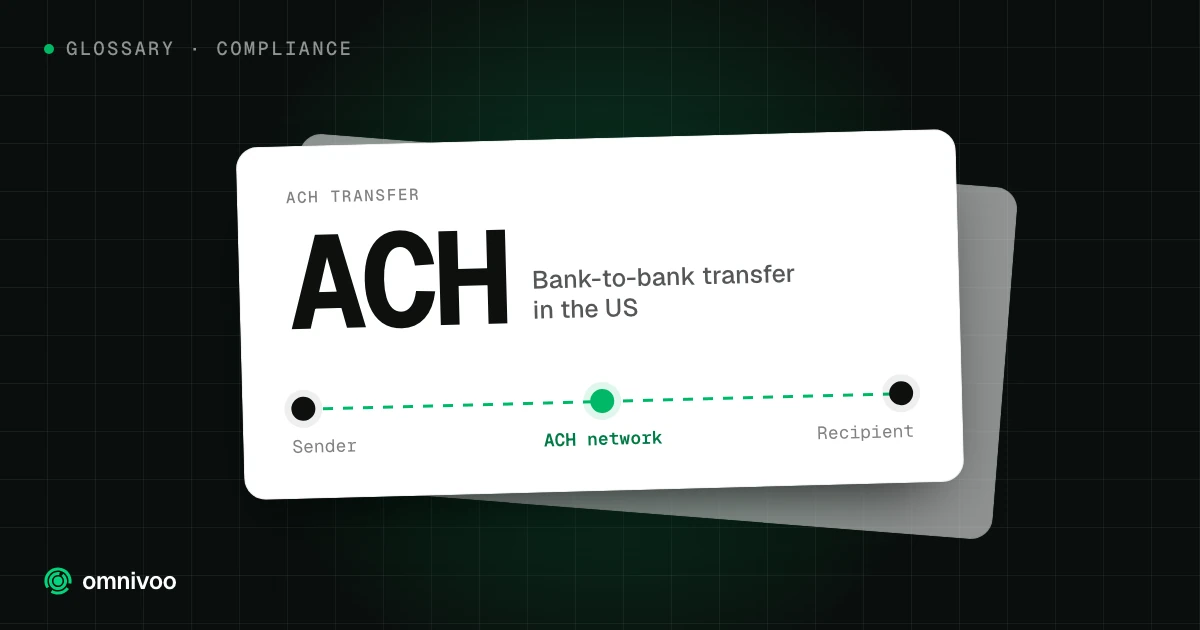
An ACH transfer is an electronic payment moved through the US Automated Clearing House network. The Federal Reserve defines it plainly: the automated clearinghouse system “is a nationwide network through which depository institutions send each other batches of electronic credit and debit transfers” (Federal Reserve, FedACH overview). The rules that govern how those batches are formatted, processed, and settled are the Nacha Operating Rules. The Federal Reserve confirms this relationship, noting that it has aligned its same-day ACH service “with Nacha’s ACH operating rules” (Federal Reserve, FedACH overview). For a US company paying a US-based contractor, ACH is usually the default rail.
ACH moves money in two directions, and the direction defines the transaction type.
Rather than settling one payment at a time, depository institutions exchange these transactions in batches. The transactions clear and settle through the network operators, and processing follows the schedules and formats set in the Nacha Operating Rules.
For US-based contractors, ACH is the practical choice for two reasons. It is low cost, because it avoids the per-transfer fees typical of domestic wires, and it is built for recurring, batched payouts, which fits a regular contractor pay schedule. A US payer collects the contractor’s US bank routing and account number once, then sends an ACH credit each pay cycle. This is the same plumbing that delivers direct-deposit payroll, which the Federal Reserve lists as a typical ACH credit use.
The trade-off is timing. Standard ACH settles on a batch schedule rather than instantly, though same-day ACH options exist under the Nacha rules for faster delivery.
This is the most important boundary to understand. The ACH network is a nationwide US system. The Federal Reserve describes it as a network through which “depository institutions send each other” transfers, and those institutions are US banks and credit unions. A plain ACH credit reaches a contractor only if that contractor holds a US bank account.
To pay a worker into a bank account outside the United States, a different mechanism is required. Cross-border payments rely on the recipient’s IBAN in countries that use it, or on the bank’s SWIFT/BIC code to route the funds internationally. These are separate networks from the domestic ACH rail. Treating ACH as an international payment method is a common and costly mistake, because an ACH transaction cannot reach a foreign account directly.
Omnivoo is the end-to-end platform for contracts, identity checks, tax documentation, and payments. For a US-based contractor it can deliver pay over the domestic ACH rail, and for a worker abroad it routes funds through the correct international method using a local bank transfer, so each payment uses the rail that actually reaches the recipient.
Compliant agreements, IP assignment, and audit-ready records in one place.
An IBAN, or International Bank Account Number, is an internationally standardized identifier for a specific bank account, defined by ISO 13616. It is built from a two-letter country code, two check digits, and a country-specific basic bank account number, and it is widely required to route cross-border transfers in Europe and many other regions.
A SWIFT/BIC code (Business Identifier Code) is an 8 or 11 character alphanumeric identifier defined by the ISO 9362 standard that uniquely identifies a financial institution, its country, location, and optionally a specific branch for routing cross-border payment messages over the SWIFT network.
In the general payments sense, a remittance is a sum of money sent from one party to another, often across borders, to settle an obligation such as an invoice or a contractor payment. In the narrower sense used by the World Bank and economists, remittances are cross-border funds that migrant workers send home to their families. The two meanings are distinct, and a business payment to an international contractor is the first, not the second.
Stop worrying about Indian payroll and compliance terms. Omnivoo manages everything (PF, ESI, TDS, professional tax, and more).
Get startedFull details in our Terms of Service →