
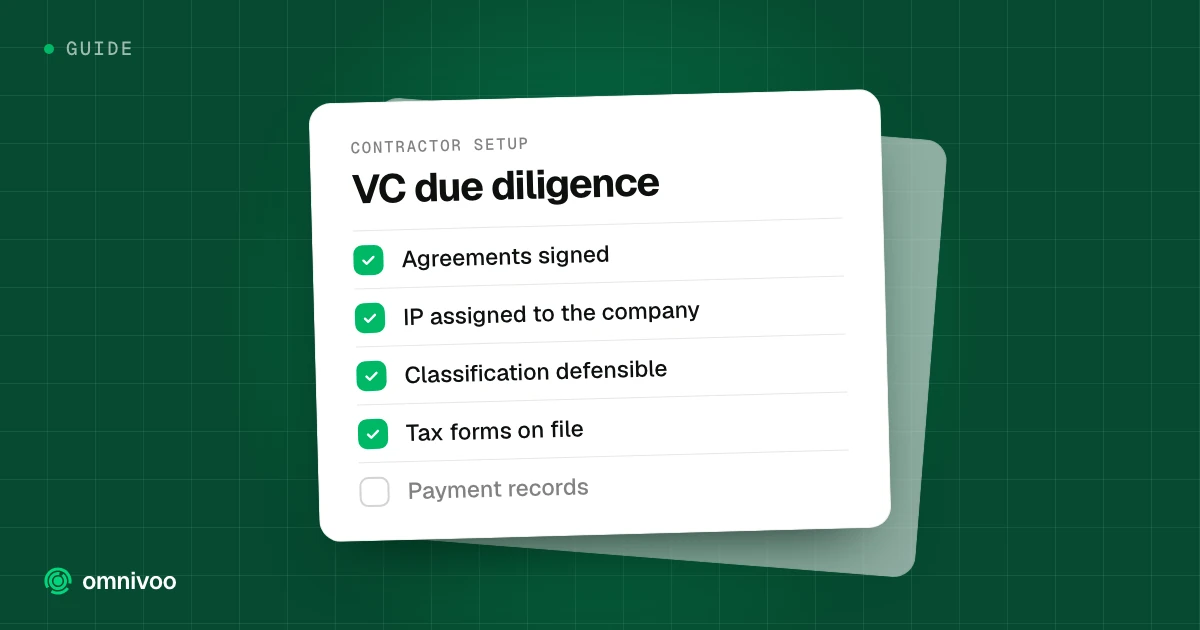
Due diligence is not just about your cap table
Most founders prepare for due diligence by cleaning up their cap table, organizing their financials, and preparing a data room with corporate documents. These are necessary. They are not sufficient.
Investors and their lawyers increasingly scrutinize contractor relationships because misclassification is an unquantified liability that sits off your balance sheet until it detonates. A single misclassified contractor can trigger back-payment of taxes, social security, and benefits that totals 20 to 40% of the contractor’s annual compensation, multiplied by the number of years the relationship existed.
For a startup with 5 contractors who have each worked for 2 years at $5,000 per month, the maximum misclassification liability is approximately $120,000 to $240,000. That is not a rounding error for a Series A company. It is a material liability that investors price into the deal or use as a reason to walk away.
The 7 areas investors check
One: Contractor agreements. Do signed contracts exist for every contractor? Are they jurisdiction-specific or generic US templates used globally? Do they include IP assignment, confidentiality, and governing law clauses?
Two: Classification assessment. Has the company assessed whether each contractor genuinely qualifies as an independent contractor under the applicable law? Is there documentation of this assessment?
Three: Tax compliance. Are the correct tax forms on file (W-9, W-8BEN, W-8BEN-E)? Are withholding obligations being met? Are 1099s or 1042-S forms filed at year-end?
Four: IP ownership. Is there a clear chain of IP assignment from every contractor who contributed to the company’s core product? Are the IP assignment clauses enforceable in the contractor’s jurisdiction?
Five: Payment documentation. Is there an audit trail linking each payment to a contract, an invoice, and the tax form on file? Or is the payment history a collection of Wise and PayPal transfers with no documentation?
Six: Data processing. If contractors access customer data, employee data, or proprietary systems, are Data Processing Agreements in place?
Seven: Termination and offboarding. When contractors leave, is there a documented process for revoking access, collecting final deliverables, and confirming IP handover?
What good looks like
The gold standard that impresses investors during diligence: a single contractor register (spreadsheet or platform dashboard) that shows every contractor’s name, country, contract status, tax form status, classification assessment result, and payment history. Every contractor has a signed, jurisdiction-specific agreement with IP assignment. Every payment is linked to an invoice and a contract. Tax forms are current (not expired). A misclassification assessment has been documented for each contractor.
This level of organization signals operational maturity. It tells the investor that the founders think about risk, that they have systems rather than ad-hoc processes, and that there are no hidden liabilities waiting to surface post-investment.
Omnivoo’s Contract Management dashboard provides exactly this view. Every contractor’s contract, tax forms, classification status, and payment history in one place. During diligence, you can export the entire register or give investor counsel read-only access to the dashboard.
How to prepare before your round
If your round is 3 to 6 months away, do this now.
Audit every contractor relationship. List every person you have paid for services in the last 12 months. For each one, confirm that a signed contract exists, a tax form (W-9 or W-8) is on file and not expired, the classification (contractor vs employee) is defensible under the applicable law, and IP assignment is documented.
Fix gaps before diligence starts. It is much better to proactively fix a compliance gap (sign a missing contract, collect an expired W-8BEN, reclassify a misclassified contractor) than to have it discovered during diligence. Proactive fixes signal awareness. Discovered gaps signal negligence.
Document your process. Investors do not expect perfection. They expect a system. Show that you have a process for onboarding new contractors (contract, tax form, classification check), a regular review cadence (quarterly classification reassessment), and a clean offboarding process (access revocation, IP confirmation, final payment).
If you do not have any of this, setting it up takes less than a day with the right tools. Omnivoo’s Contract Management can onboard all your existing contractors with contracts, tax forms, and classification assessments in a single session.