
Upwork is a marketplace, not a compliance platform
This distinction matters more than most founders realize. Upwork’s primary function is matching clients with freelancers and facilitating payments between them. It is exceptionally good at this. But compliance, the legal and tax infrastructure that protects both parties, is not its core product.
Upwork’s terms of service provide a basic contractual framework, but they do not replace the jurisdiction-specific compliance that cross-border contractor engagements require. When a tax authority audits your contractor relationships, they do not care that you used Upwork. They care whether you collected the right tax forms, withheld the correct amounts, filed the required returns, and classified the worker correctly under local law.
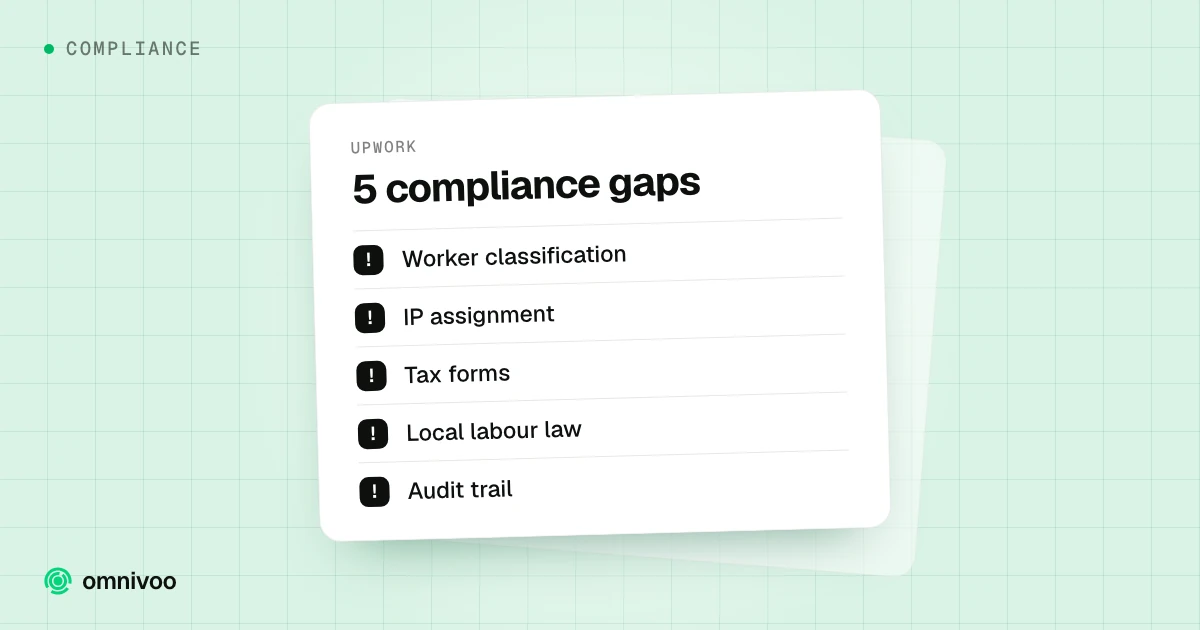
Here are the five compliance gaps that Upwork’s platform does not address, and what you should do about each one.
Gap 1: Misclassification risk assessment
Upwork classifies every worker on its platform as an independent contractor. But legal classification is not determined by what a platform calls someone. It is determined by the actual working relationship under the applicable labor law.
If your Upwork freelancer works full-time hours for you, uses your tools, attends your meetings, and does not serve other clients, they may legally be an employee under the IRS common-law test, UK IR35 rules, German Scheinselbstaendigkeit doctrine, or the Indian labor law substance-over-form approach.
Upwork does not assess this risk. It does not analyze the hours, exclusivity, control, or economic dependence factors that determine classification.
What to do: Run a misclassification assessment on every freelancer who has worked for you for more than 3 months or who works more than 20 hours per week. Omnivoo’s misclassification risk self-check tool is free and evaluates the key IRS-rooted risk factors. For freelancers who score medium or high risk, either restructure the engagement to restore independence or convert to employment through an EOR.
Gap 2: Tax withholding on international payments
For US freelancers, Upwork handles 1099 reporting above the threshold. But for international freelancers, Upwork does not compute or deposit tax withholding.
Many countries require the payer to withhold tax at source when paying contractors. India requires TDS on payments for professional and technical services. The UK may require WHT on certain payments. The US requires 30% FDAP withholding on US-source payments to foreign persons unless a treaty reduces the rate.
Upwork moves the money. It does not compute what should have been withheld before the money moved.
What to do: For every international freelancer, determine the withholding obligation based on both parties’ countries and the nature of the services. Collect the appropriate tax forms directly from the freelancer. Use a contractor management platform that computes withholding based on the specific country pair and service type.
Gap 3: Jurisdiction-specific contracts
Upwork’s terms of service apply uniformly to all engagements regardless of where the client or freelancer is located. A freelancer in Germany operates under the same Upwork terms as one in the Philippines.
But labor law is not uniform. A contractor agreement that is enforceable in the US may be insufficient in Germany, Brazil, or India. Each jurisdiction has specific requirements for governing law, IP assignment, termination provisions, and statutory clauses.
What to do: Generate a jurisdiction-specific contractor agreement that operates alongside Upwork’s terms. Omnivoo’s document generator creates contracts with governing law, IP assignment, and statutory clauses based on both parties’ countries. The document generator is free.
Gap 4: IP ownership certainty
Upwork’s terms include a clause that transfers IP from the freelancer to the client. This provides baseline protection. But the enforceability varies by jurisdiction, and the scope may not cover pre-existing IP that the freelancer incorporates into your work.
The risk is most acute for software development. If a freelancer writes code that uses their pre-existing libraries, the IP assignment may transfer the custom code but not the underlying dependencies.
What to do: Whether you stay on Upwork or not, sign a separate IP assignment agreement with the freelancer that explicitly covers all work product, is governed by the appropriate jurisdiction, and addresses pre-existing IP.
Gap 5: Data processing governance
If your freelancer accesses customer data, employee records, or any personally identifiable information, you need a Data Processing Agreement between you and the freelancer. Upwork’s platform terms cover Upwork’s data handling, not how the freelancer handles your data.
Under GDPR, CCPA, and India’s DPDP Act, the company that controls the data is responsible for ensuring anyone who processes it does so under a valid DPA. Upwork does not facilitate DPAs between clients and freelancers.
What to do: For every freelancer who accesses personal data, generate a DPA that specifies what data they may access, their security obligations, data retention and deletion terms, and your audit rights. Omnivoo’s document generator creates jurisdiction-specific DPAs covering GDPR, CCPA, and DPDP requirements for free.